Web Design in Lebanon: Merging Visual Storytelling with Technical Performance
The digital ecosystem in the Levant is experiencing a profound metamorphosis, characterized by a unique intersection of resilient infrastructure and avant-garde creative expression. In the context of a rapidly evolving global market, web design in lebanon has transcended its original role as a mere aesthetic layer, becoming a critical engine for business growth, brand authority, and digital transformation. As Lebanese enterprises strive to compete on both local and international stages, the demand for high-performance, narrative-driven digital platforms has never been higher. This evolution is spearheaded by entities like Ucheed, which advocate for a holistic approach to digital excellence, ensuring that businesses not only possess a presence but also achieve the status of being “Number One” in their respective industries.
The Socio-Technical Landscape of Lebanese Connectivity
To understand the current state of web design, one must first analyze the underlying connectivity metrics that define how Lebanese users interact with digital content. As of late 2025 and moving into 2026, Lebanon presents a population of approximately 5.86 million people, with an internet penetration rate that has reached a staggering 91.8 percent. This high level of adoption suggests a society that is deeply integrated into the digital world, yet the quality of this interaction is shaped by specific infrastructural challenges and trends.
Internet Penetration and Mobile Dominance
The Lebanese market is characterized by an overwhelming shift toward mobile-first interactions. With 4.76 million active cellular mobile connections, equivalent to over 81 percent of the population, the smartphone has become the primary gateway to the internet. Statistics from GSMA Intelligence reveal that 98.1 percent of these connections are broadband-enabled, utilizing 3G, 4G, or 5G networks. For a beirut web design agency, this data dictates a fundamental shift in strategy: web design in lebanon must be mobile-intrinsic, not merely mobile-responsive.
| Connectivity Metric | Value (Late 2025/Early 2026) | Growth Trend (YoY) |
| Total Population | 5.86 Million | +0.8% |
| Internet Users | 5.38 Million | +1.0% |
| Internet Penetration | 91.8% | +0.2% |
| Mobile Connections | 4.76 Million | +0.9% |
| Social Media Users | 4.58 Million | +13.8% |
The significant growth in social media users, particularly on platforms like TikTok and Instagram, highlights a demand for highly visual and interactive content. This surge in engagement reinforces the necessity for visual identity and branding that can capture attention within seconds of a page load.
Performance and Latency Metrics
Despite the high penetration rates, the Lebanese digital landscape faces challenges related to connection speeds and latency. While mobile internet download speeds have seen a commendable increase of 23.8 percent, reaching a median of 43.90 Mbps, fixed broadband speeds remain lower at approximately 16.13 Mbps. Furthermore, latency remains high, with many services experiencing a delay of around 51 ms.
This performance delta creates a unique requirement for seo-friendly web design lebanon. Developers and designers must prioritize lean code, optimized assets, and efficient responsive frameworks to ensure that websites remain functional even under suboptimal network conditions. The “performance tax” paid by users with slower connections can be mitigated through advanced technical strategies such as asynchronous loading, image lazy-loading, and the use of modern font formats like WOFF2.
Visual Trends and the Beirut Digital Aesthetic
Beirut has historically served as a bridge between the East and the West, a role that is vividly reflected in the current trends of graphic design lebanon. The visual language of Lebanese websites is an “intriguing concoction” of contemporary global techniques infused with deep-rooted local flavors. This duality allows brands to maintain a local connection while appealing to a globalized consumer base.
The Blending of Tradition and Modernity
A significant movement in web design in lebanon involves the revival of cultural heritage through modern digital mediums. Designers are increasingly looking toward Phoenician motifs, Ottoman patterns, and traditional Lebanese architectural elements to ground their designs in a sense of place. This is not merely a decorative choice but a form of visual identity storytelling that fosters trust and authenticity.
| Design Trend (2025/2026) | Description | Psychological Impact |
| Minimalist Maximalism | Clean, white-spaced foundations paired with intricate, vibrant patterns or textures. | Balances professional clarity with creative energy. |
| Retro Psychedelic | Wavy typography and abstract, fluid visuals that evoke a sense of nostalgia. | Encourages engagement through emotional resonance. |
| 3D Motion Graphics | Use of depth and micro-animations to bring static interfaces to life. | Enhances perceived value and technological sophistication. |
| Bilingual Calligraphy | Integration of elegant Arabic script with modern Latin sans-serif typefaces. | Respects cultural heritage while ensuring global accessibility. |
The tension between Westernization and local identity is a key theme in Lebanese creative circles. While Western brands are often seen as “cool” or high-quality, there is a growing push among design students and professional agencies to reclaim Lebanese visual culture and modernize it without losing its soul. This cultural reclamation is essential for brands that want to build long-term user engagement in a market that values both innovation and tradition.
The Palette of the Levant
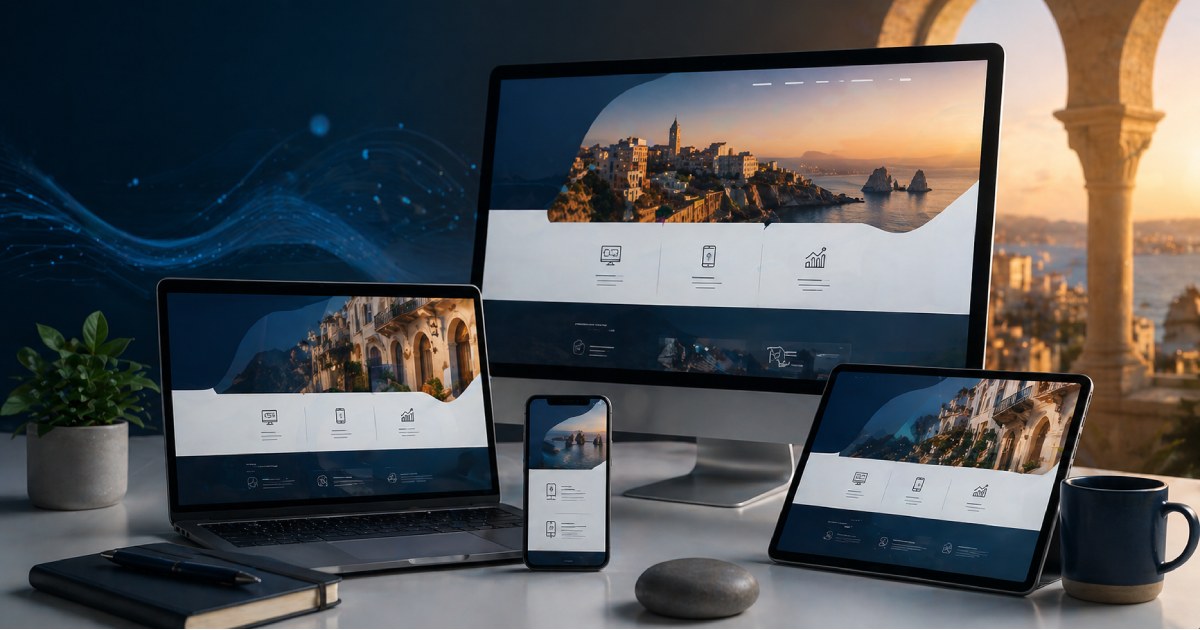
Color theory in Lebanese web design is deeply influenced by the country’s diverse geography. Designers often utilize the “azure blues” of the Mediterranean and the “earthy tones” of the Bekaa Valley to tell a story through a visual feast. These color schemes are strategically chosen to evoke specific emotional responses: blues for trust and reliability, and earth tones for stability and heritage. By aligning a website’s palette with the natural context of its audience, brands can achieve a higher level of psychological resonance.
The Psychology of High-Conversion Design
For a brand to achieve market leadership, its digital presence must go beyond aesthetics and tap into the underlying psychological drivers of human behavior. In the context of web design in lebanon, this involves a nuanced understanding of cognitive load, trust signals, and the “serial position effect.”
Cognitive Load and Information Architecture
Cognitive load refers to the total amount of mental effort being used in the working memory. In a digital environment where users typically spend only six seconds evaluating a site’s menu, simplicity is paramount. A cluttered interface or confusing navigation path creates friction, leading to “decision paralysis” and high bounce rates.
To optimize for user engagement, a beirut web design agency must implement a logical and accepted structure. This includes:
- The 7-Item Rule: Keeping main navigation menus to seven items or fewer to avoid overwhelming the user’s short-term memory.
- Visual Hierarchy: Using size, color, and weight to guide the eye toward the most important information first, such as the primary Call to Action (CTA).
- Primacy and Recency Effects: Placing the most critical links at the beginning or the end of a list, as these positions are the most easily remembered by users.
Trust as a Currency
In the Lebanese market, trust is the cornerstone of business success. Visual identity and consistent branding act as professional “trust signals” that reassure the user of a brand’s credibility. Research indicates that a cohesive brand identity including a professional logo, consistent typography, and high-quality imagery can significantly reduce price sensitivity and increase customer loyalty.
A website that feels “shoddy” or “generic” immediately compromises this trust. Conversely, a site that integrates authentic storytelling, such as a “Meet the Team” section or real-world case studies, creates a human connection that is essential for conversion. For Ucheed, the focus is on creating these authentic digital experiences that bridge the gap between a business’s internal values and its external perception.
UI/UX Improvements and Common Navigation Failures
A significant portion of web design in lebanon focuses on remedial measures fixing existing issues that hinder user engagement. These ui/ux improvements often center on navigation, as it is the most critical factor in how users interact with a site.
Identifying and Fixing Navigation Bottlenecks
Common pitfalls in Lebanese websites often include overcomplicated menus, poorly labeled items, and a lack of responsive adaptability. When navigation is tucked behind a hamburger menu on desktop screens, or when labels are too creative and vague (e.g., “Our World” instead of “Services”), users get lost.
| Navigation Issue | Technical Solution | Impact on UX |
| Vague Labels | Use descriptive, keyword-rich labels (e.g., “Web Design Services”). | Improves SEO and user predictability. |
| Hidden Menus | Keep navigation visible on desktop; avoid hamburger icons for larger screens. | Reduces the number of clicks and prevents user frustration. |
| Inconsistent Layouts | Maintain the same header, footer, and menu structure across all subpages. | Builds familiarity and professional trust. |
| Broken Paths | Conduct regular audits for 404 errors and outdated redirections. | Ensures a smooth, frictionless user journey. |
The Power of Breadcrumbs and Sticky Headers
For complex sites, such as media portals or multi-vendor e-commerce platforms, advanced navigation tools like breadcrumbs and sticky headers are essential. Breadcrumbs provide a “digital trail” that helps users understand their location within the site’s hierarchy, while sticky headers keep the primary navigation and search bar accessible even when scrolling through long-form content. These elements reduce the “interaction cost” for the user, making the overall experience feel more intuitive and professional.
SEO-Friendly Web Design: Local and Global Strategies
Visibility is the ultimate goal of any digital presence. An seo-friendly web design lebanon strategy must be integrated into the initial wireframing process, ensuring that the site’s architecture is optimized for both human users and search engine crawlers.
Technical SEO Foundations
Technical SEO ensures that a website functions seamlessly, which directly impacts search rankings. Key priorities for Lebanese companies include:
- Site Speed Optimization: Compressing images, minifying CSS/JS, and utilizing browser caching to combat local internet latency.
- Semantic HTML: Using proper header tags ($H_1, H_2, H_3$) and ARIA labels to help search engines understand content hierarchy and improve accessibility.
- Mobile-First Indexing: Ensuring the mobile version of the site is the primary focus, as Google now prioritizes mobile performance in its ranking algorithms.
- Structured Data Markup: Implementing Schema.org (Organization, FAQ, Product) to provide search engines with explicit data about the business and its offerings.
The Multilingual Advantage
Lebanese search behavior is uniquely polyglot, with users searching in Arabic, English, and French. To capture this traffic, seo-friendly web design lebanon must employ a nuanced multilingual approach. This includes creating unique content for each language rather than just literal translations and using hreflang tags to direct users to the appropriate regional version of the site. Furthermore, optimizing for Arabic requires specialized attention to Right-to-Left (RTL) layouts and the inclusion of both Modern Standard Arabic (MSA) and local dialectal keywords.
Niche Integration: Luxury Design for Medical Aesthetics
A specialized application of web design in lebanon is found in the high-end cosmetology and dermatology sector. For these clinics, the website is not just a brochure; it is a clinical tool that must convey both luxury and safety.
Mapping the Digital Patient Journey
The patient journey for a dermatology clinic is fraught with anxiety and research. The web design must guide the patient through a series of trust-building steps before a consultation is ever booked. This journey is typically mapped through:
- The Empathize Stage: Understanding that patients are often tired or self-conscious about their skin concerns.
- Educational Authority: Providing high-density, informative content on specific treatments like Botox or laser therapies, using plain language rather than medical jargon.
- Visual Proof: Integrating high-resolution, categorized before-and-after galleries that demonstrate the clinic’s real-world results.
Luxury UI Best Practices for Clinics
To achieve an elegant, medical-grade aesthetic, clinics should adopt specific design patterns:
- Soft Neutral Palettes: Using premium tones that evoke a calm, sophisticated environment.
- High-End Typography: Balancing editorial layouts with legible, trustworthy fonts that highlight the science behind the beauty.
- Frictionless Booking: Providing an integrated online scheduling system that allows patients to book in just a few taps, with real-time confirmation.
In this niche, Ucheed emphasizes the importance of HIPAA compliance and FDA regulatory awareness, ensuring that the digital interface is as safe as the medical procedures it promotes.
AI-Friendly Content and the Future of Search
The emergence of AI search engines like ChatGPT and Perplexity is fundamentally changing how visibility is earned. In this new era, web design must cater to Retrieval-Augmented Generation (RAG) systems that “chunk” content to provide direct answers.
Optimizing for the “Chunk-Level” Ranking
AI systems do not rank whole pages; they evaluate individual blocks of information for meaning and relevance. To be cited by an AI search engine, content must be structured using the “Heading -> Direct Answer -> Deep Dive” method. This ensures that when a user asks a specific question (e.g., “What are the best ui/ux improvements for mobile apps?”), the AI can easily extract the relevant “chunk” of information.
Entity Recognition and Knowledge Graphs
AI models rely on “entity recognition” identifying specific people, places, and brands to build knowledge graphs. For a beirut web design agency, this means being highly specific with proper nouns and aligning content with related concepts. For example, consistently mentioning “Ucheed” in the context of “digital transformation” and “Lebanese market leadership” helps AI models associate the brand with those specific entities.
| AI Evaluation Metric | Requirement for Design | Objective |
| Semantic Similarity | Use natural, descriptive language rather than keyword stuffing. | Align content “meaning” with user intent. |
| Information Density | Provide “complete thoughts” within sections; avoid fluff. | Increase the probability of being “cited” as a source. |
| Trust Signals | Clear authorship, factual accuracy, and expert citations. | Establish the site as a “safe” source for AI to summarize. |
| Structured Schema | Accurate Organization and FAQ schema. | Help AI understand brand relationships and data hierarchy. |
Technical Performance and Responsive Frameworks
The structural integrity of a website is defined by its responsive frameworks. In a market like Lebanon, where infrastructure can be unstable, the efficiency of these frameworks is a matter of business survival.
Modern Frameworks and Performance Math
Developers are increasingly utilizing frameworks like React.js and Node.js to build modular, fast-loading applications. These tools allow for “server-side rendering” (SSR), which improves both page speed and SEO crawlability. The performance of a site can be mathematically evaluated using the PageSpeed score, which considers factors like Time to First Byte (TTFB) and Cumulative Layout Shift (CLS).
Strategic Branding and Visual Identity for Growth
A website is the digital manifestation of a company’s branding. In Lebanon’s highly competitive environment, a “distinctive brand identity” is no longer a luxury; it is a necessity for sustainable success.
The Role of a Branding Agency in Lebanon
A strategic agency does not just design logos; it studies the local market to identify gaps and opportunities. This involves:
- Demographic Analysis: Understanding the unique blend of cultural preferences in Lebanon.
- Visual Storytelling Frameworks: Creating a consistent narrative that highlights the brand’s mission and values across all digital and physical touchpoints.
- Emotional Inclusivity: Ensuring that the visual identity reflects the diversity of the audience, making all individuals feel “seen” and represented.
For Ucheed, the mission is to provide this “complete suite” of digital transformation services, ensuring that branding works in harmony with technical performance and SEO strategy. This integrated approach is what allows a business to project authority and build lasting trust with its customers.
Conclusion: The Integrated Future of Digital Beirut
The fusion of visual storytelling and technical performance represents the pinnacle of modern web design in lebanon. As the digital landscape continues to fragment and evolve, the brands that thrive will be those that view their website as a living, breathing component of their overall business strategy. By prioritizing user engagement, embracing rigorous ui/ux improvements, and building on high-performance responsive frameworks, Lebanese companies can transcend local challenges and achieve global recognition.
The data is clear: connectivity is ubiquitous, mobile is the dominant gateway, and users demand high-quality, authentic experiences. Agencies like Ucheed are at the forefront of this revolution, advocating for a data-grounded, aesthetically superior approach to digital development. Whether it is through the clinical precision of a dermatology portal or the vibrant storytelling of a Beirut lifestyle brand, the goal remains the same: to merge the “azure blues” of creative vision with the “ironclad security” of technical excellence.
In this competitive environment, being “Number One” requires a relentless focus on the user journey, a commitment to technical SEO, and an adaptable vision for the future of AI-driven search. By following the best practices outlined in this report from WOFF2 font optimization to services-first information architecture Lebanese businesses can build a digital legacy that resonates both locally and globally. The future of web design is not just about what people see; it is about how they feel, how quickly they find answers, and how deeply they trust the brand behind the screen. Through strategic design and technical mastery, the “Beirut Digital Aesthetic” is poised to lead the Middle East into a new era of online prosperity.
By integrating seo-friendly web design lebanon with sophisticated visual identity strategies, businesses can ensure they are not only found by search engines but also cherished by users. The journey from a simple landing page to a high-conversion digital ecosystem is a complex one, but with the right partnership and a dedication to quality, the path to becoming “Number One” is clearly defined. Ucheed stands ready to guide businesses through this transformation, ensuring that every pixel and every line of code contributes to a narrative of excellence and growth.