Lebanon’s developer community is one of the Middle East’s best-kept secrets — and one of its most misunderstood hiring markets. Founders who search for “app developers in Lebanon” find directories, agency profiles, and freelancer listings. What they don’t find is a straight answer to the question that actually matters: who should build my app, and how do I evaluate them before I wire money to a stranger?
This guide answers that. It is written for Lebanese founders, SME owners, and regional companies looking to build a mobile or web app with a team that understands the local market, the currency reality, and the difference between an MVP and a money pit.
What Changed in Lebanon’s App Dev Market in 2026
Three forces reshaped the landscape since 2023:
- The diaspora reversal. Post-crisis emigration hollowed out mid-level dev talent, but remote-work normalisation brought some back — not physically, but contractually. Lebanese agencies now run hybrid teams with diaspora senior engineers (based in Canada, UAE, Germany) supervising local junior builds. This raises quality ceilings but complicates communication time zones.
- AI-assisted development. Tools like GitHub Copilot and Cursor reduced solo-dev build time by 30–50% on standard app features. Agencies now deliver MVPs faster, but the gap between AI-assisted agencies (who pass savings on) and those who don’t has widened.
- USD-pegged billing. Since 2022, virtually all Lebanese tech firms bill in USD or fresh dollars. Rate transparency has improved — clients no longer negotiate in lollars — but rates vary by 3× between freelancers and full agencies.
1. In-House vs. Agency vs. Freelance vs. Offshore — The Decision Framework
Before you evaluate any specific developer, pick the right engagement model. Each has a ceiling and a floor.
| Model | Best for | Cost range (USD) | Main risk |
|---|---|---|---|
| In-house hire | Long-term, iterative products with high internal IP | $1,500–$3,500/mo/dev | Salary continuity if the product pivots |
| Lebanese agency | End-to-end delivery, design + build + maintenance | $8,000–$50,000+ per project | Agency bandwidth when they win other clients |
| Lebanese freelancer | Short scope: API integration, feature add-on | $20–$55/hr | No project management, continuity risk |
| Offshore team | Cost-first, low-complexity builds | $15–$30/hr (South Asia), $30–$50/hr (Eastern Europe) | Timezone friction, no local market knowledge |
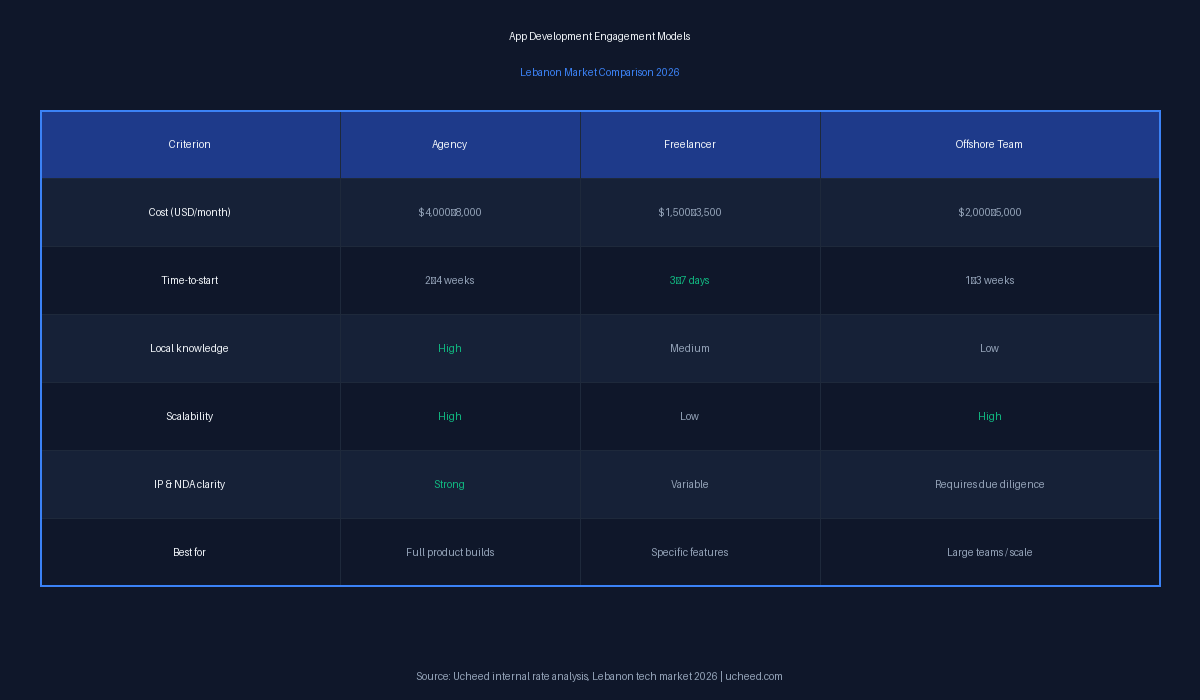
Verdict for most Lebanese SMEs: A Lebanese agency or a hybrid (agency + dedicated senior dev) outperforms offshore for anything that needs Arabic-first UX, local payment-gateway integration, or ongoing post-launch support from someone you can reach by WhatsApp.
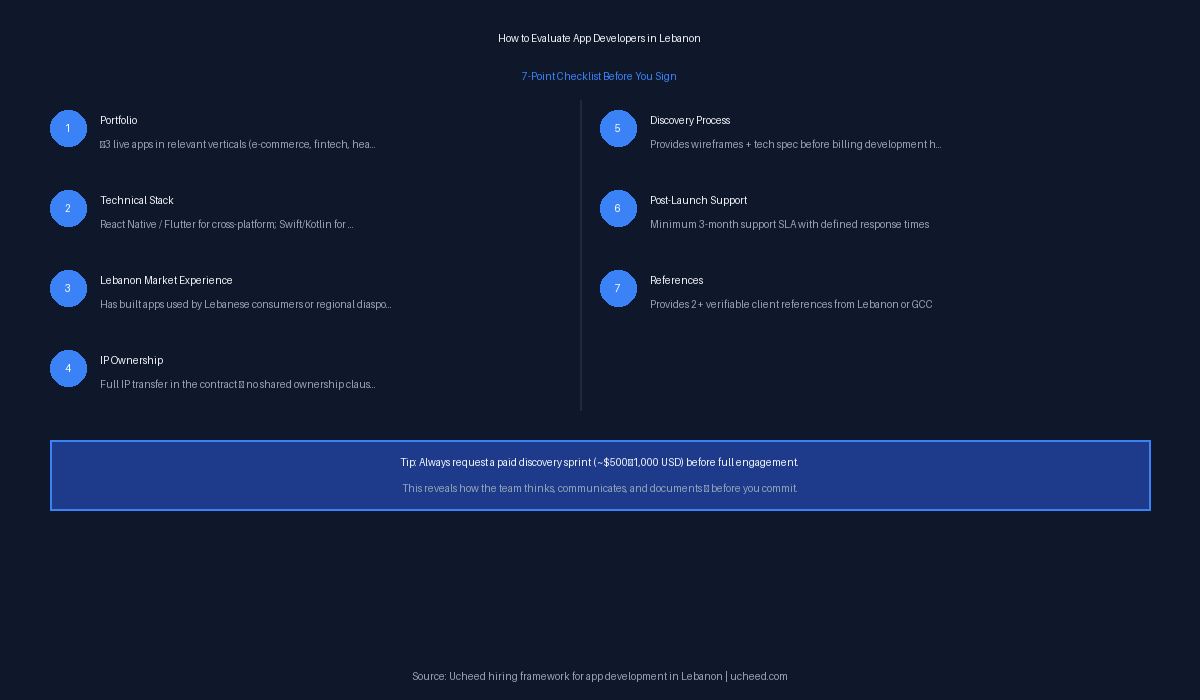
2. How to Evaluate App Developers in Lebanon
A portfolio is necessary but not sufficient. Here is the evaluation checklist that separates agencies who can build your app from those who will bill you while learning.
The six things to check:
- Arabic/RTL experience — Ask for a live link to a deployed app with Arabic content. Right-to-left layout, font rendering, and input direction are non-trivial; you’ll catch capability gaps immediately.
- Local payment-gateway integration — Have they integrated Areeba, Bank Audi, or WHISH payment in production? Lebanon’s banking infrastructure is idiosyncratic; offshore teams consistently underestimate this.
- Cross-platform stack clarity — Do they default to Flutter, React Native, or native Swift/Kotlin? There’s no wrong answer, but they should have a clear reason based on your requirements.
- Post-launch SLA — Ask: what happens when the app crashes at 2 AM on a Sunday? Who responds? In what timeframe? A “we’ll look at it Monday” answer tells you everything.
- App Store / Play Store publishing history — Have they published under their own or client accounts? Can they handle the review process, privacy policies, and update cycles? Ask whether they can navigate the requirements in Apple’s App Store Review Guidelines and Google’s Play Console publishing policies — first-timers underestimate this by a month.
- Client references in Lebanon — One verifiable local client you can call is worth ten logos on a homepage.
3. What App Development Costs in Lebanon
Cost transparency is what directories and agency websites systematically avoid. Here are real USD ranges, calibrated to Lebanon’s 2026 market.
| App type | MVP scope | Agency range (USD) |
|---|---|---|
| Simple utility app | Auth + 3–5 screens + basic backend | $6,000–$14,000 |
| Marketplace / two-sided platform | Buyer/seller flows, listings, payments | $18,000–$45,000 |
| Enterprise mobile app | ERP/Odoo integration, complex permissions | $35,000–$80,000+ |
| AI-enhanced app | LLM features, voice, recommendation engine | $25,000–$60,000+ |
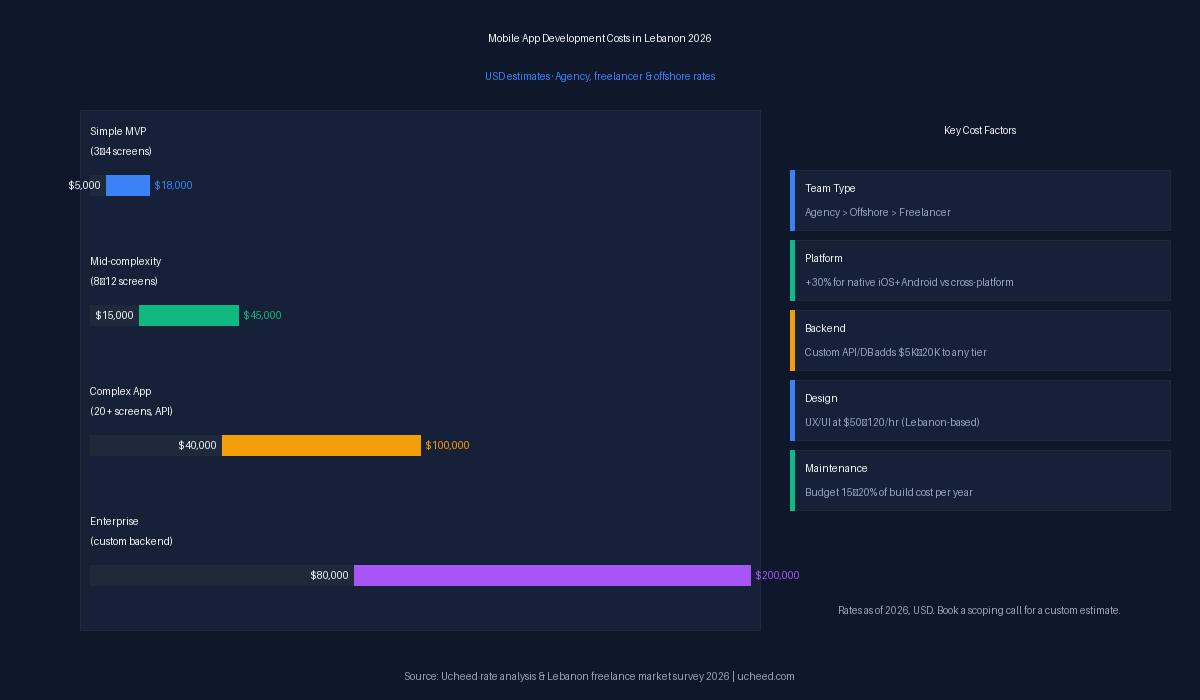
Note: These are project ranges. Maintenance retainers typically run 15–20% of build cost annually.
What drives cost up in Lebanon specifically:
– Arabic localisation + RTL testing adds ~10–15% to front-end cost
– Local bank and payment integration adds $2,000–$6,000 in engineering effort
– App Store + Play Store dual submission and ongoing compliance adds $800–$2,000
4. Why Work With a Local Lebanese App Team
Offshore teams cost less per hour. That calculus inverts fast when you account for:
Timezone alignment. A 9 AM call in Beirut is midnight in India. Bug triage that takes 30 minutes in a Beirut office takes two async days offshore.
Arabic-first UX. Designers who grew up using Arabic apps know instinctively where a menu belongs, how RTL pagination feels, and why a Lebanese user will tap “Cancel” when an international UX convention expects “OK.” That knowledge is not taught — it is absorbed.
MENA market knowledge. Lebanon is a proxy market for GCC and regional expansion. A Lebanese agency that has built for Saudi, UAE, and diaspora clients understands the regulatory edge cases, currency realities, and support expectations. Offshore teams are building for a market they don’t live in.
On-ground accountability. You can schedule a meeting at a café. That accountability asymmetry matters when delivery milestones slip. This is exactly the model we run on our Mobile App Development service in Lebanon — local senior developers, accountable delivery, and post-launch support you can actually reach.
5. Structuring the Engagement — What to Get in Writing
Even the best team delivers better with the right contract structure.
Five non-negotiables in your development agreement:
- Scope document with screen-level detail before a line of code is written — vague scope is how projects double in cost
- Milestone-based payments (discovery → wireframes → build → QA → launch), not 50% upfront / 50% on “completion”
- Source code escrow clause — if the agency closes, you own the code
- Explicit IP assignment — standard in professional contracts but often absent in Lebanon; ask for it explicitly
- Maintenance terms post-launch — minimum 30-day bug-fix warranty, clear path for ongoing support
6. Red Flags That Predict a Bad App Build
Six signals that should make you walk away:
- They quote you a price before asking about your users, flows, or integration requirements
- Their portfolio is mock-ups only — no deployed, live apps you can download and test
- They can’t explain why they chose the stack they recommend
- They have no dedicated QA resource; “the developer tests their own work”
- They can’t name a single previous client you can call for a reference
- They are the cheapest option by more than 30% and can’t explain why
The Compounding Effect of Getting the Team Right
The right app developer doesn’t just build version 1 — they build a codebase that version 2 can be added to without a full rewrite. Lebanese founders who cut corners on hiring often discover this the hard way: a $9,000 MVP that can’t be extended becomes a $40,000 replatform 18 months later. (The same architecture-first thinking applies beyond apps — see our framework for custom software development in Lebanon for the decisions that determine whether a build scales.)
Getting the team selection right compounds the other way too. A team that knows your market, speaks Arabic natively, and has built in Lebanon before ships faster, integrates payment rails without surprises, and provides post-launch support that resolves critical bugs before users churn.
That is not a hiring luxury — it is a delivery multiplier.
How Ucheed Approaches App Development in Lebanon
Ucheed is a Lebanese digital agency that builds mobile and web applications for founders, SMEs, and enterprise clients across Lebanon, the GCC, and the wider MENA region.
Our team brings together:
– Native Lebanese developers with Arabic-first design and RTL engineering experience
– Local payment-gateway and banking integration (Areeba, Bank Audi, WHISH, and others)
– Cross-platform mobile development in Flutter and React Native, plus native iOS/Swift and Android/Kotlin for performance-critical builds
– Post-launch SLA with defined response-time commitments, not “we’ll get to it”
You can see the full scope of what we build on our mobile apps development service page. Every engagement starts with a scoped discovery session — no build commitment until both sides understand the full scope, timeline, and budget.
→ Book a free 30-minute discovery call and tell us what you’re building. We’ll tell you whether it’s a 6-week MVP or a 6-month platform — and what it will actually cost.
FAQ: App Developers in Lebanon
How much do app developers charge in Lebanon?
Lebanese app developers charge $20–$55/hour for freelancers and $8,000–$50,000+ per project for agencies, depending on complexity. An MVP for a simple utility app typically costs $6,000–$14,000. Enterprise applications with ERP integration or AI features run $35,000–$80,000+.
Should I hire a local Lebanese developer or go offshore?
For apps that need Arabic/RTL support, Lebanese payment-gateway integration, or close ongoing collaboration, a local Lebanese team typically delivers faster and with fewer hidden costs. Offshore works for simple, well-specified builds with no local-market dependencies.
Do Lebanese app developers build for both iOS and Android?
Yes. Most Lebanese agencies offer cross-platform development (Flutter or React Native) that covers both platforms from a single codebase, plus native iOS (Swift) and Android (Kotlin) for performance-critical or platform-specific projects.
What should I look for in an app development contract in Lebanon?
Key contract terms: screen-level scope document, milestone-based payments, source code ownership clause, explicit IP assignment, and post-launch bug-fix warranty (minimum 30 days). Avoid any contract with vague deliverables or a single large upfront payment.
How long does it take to build an app in Lebanon?
A simple utility app MVP typically takes 6–12 weeks from scoped discovery to App Store submission. A marketplace or two-sided platform takes 4–9 months. Enterprise apps with complex integrations run 6–18 months. These timelines assume scoped requirements upfront — starting without a clear scope document adds 4–8 weeks.