Hacker Bought WordPress Plugins, Waited 8 Months

A hacker bought the most popular WordPress plugins, and waited 8 months to do this The digital landscape of 2026 has witnessed what cybersecurity experts now describe as the “Great Trust Breach.” In a carefully orchestrated supply-chain attack, hackers moved far beyond traditional brute-force methods and exploited the very foundation of the WordPress ecosystem: trust between plugin developers and website owners. By secretly purchasing and compromising more than 30 legitimate plugins, cybercriminals used the official update system to infect over 200,000 websites worldwide. This incident rapidly became known as the latest WordPress attack 2026, raising major concerns about how WordPress sites get hacked and why businesses are investing more heavily than ever in WordPress malware protection to protect WordPress website infrastructure against evolving WordPress security threats. For most website owners, the consequences were devastating. Years of SEO authority, rankings, and organic traffic disappeared almost overnight. Yet for a smaller group of businesses using Ucheed’s technical SEO maintenance and protection services, the crisis barely caused disruption. While competitors rushed to recover hacked pages and remove malware, Ucheed clients continued climbing search engine rankings without interruption. In this detailed analysis, we examine the anatomy of the 2026 breach, the direct relationship between cybersecurity and SEO performance, and the strategic architecture that enabled Ucheed to serve as a highly secure fortress for its partners. The Anatomy of a “Long Con”: How 30+ Plugins Became Weapons The WordPress attack of 2026 was not a sudden event. It was a patient and calculated operation. The attackers understood that modern WordPress firewalls are increasingly effective at blocking direct intrusions, so they chose a more sophisticated route: legitimate access. The Acquisition Phase Beginning in late 2025, several shell companies connected to an international hacking syndicate quietly approached developers of mid-sized WordPress plugins. Their targets included trusted utilities with long histories, excellent ratings, and active installations between 5,000 and 50,000 websites. These plugins included: Image optimization tools Lightweight SEO helpers Custom CSS utilities Performance enhancement plugins Most developers were independent creators or small teams looking to sell their projects. The purchases appeared completely legitimate. Ownership changed quietly, without public warnings or visible red flags. The Dormancy and Intelligence Gathering Phase After acquiring control of these plugins, the attackers avoided suspicious activity. Instead, they released several normal-looking “maintenance updates” that genuinely improved plugin performance. This increased user trust and encouraged site owners to keep automatic updates enabled. Hidden within these updates was a lightweight “scout” script that quietly collected data, including: PHP versions and server configurations Administrator usernames and login habits Installed security systems XML sitemaps and top-performing pages Most importantly, the malware identified high-traffic pages suitable for SEO spam injection. The Activation Phase In early 2026, the hackers triggered a remote “Kill Command” through command-and-control servers. The dormant malware activated simultaneously across thousands of websites. Core WordPress files such as: functions.php wp-config.php were remotely modified. Within hours, more than 200,000 websites became part of a coordinated botnet designed to manipulate search rankings, spread malicious redirects, and distribute harmful content. The Invisible Threat: Why Traditional Security Failed The 2026 breach revealed a serious reality: standard WordPress security practices are no longer enough. Many website owners believed they were protected because they: Used strong passwords Installed firewalls Updated plugins regularly Ironically, these “safe” habits became the attack vector itself. Because the malware arrived through trusted plugin updates distributed from official channels, many traditional security systems allowed the code to pass undetected. The malware also used advanced “Dynamic Cloaking” techniques: Website administrators saw normal pages Googlebot visitors saw spam content Mobile users from search engines were redirected to malicious websites As a result, site owners remained unaware while their SEO rankings and brand reputation collapsed behind the scenes. The SEO Massacre: How Hacked Plugins Destroy Revenue The main objective of the 2026 attack was not website destruction it was authority theft. Search engine rankings represent digital trust and revenue. By compromising thousands of websites, hackers gained access to billions of dollars in SEO value. SEO Spam and Manual Penalties After activation, the malware generated hidden “Shadow Pages” promoting: Illegal gambling Fake pharmaceuticals Cryptocurrency scams These pages were invisible to normal users but visible to search engines. Google’s 2026 algorithms, which place stronger emphasis on security signals, quickly detected these manipulative patterns. Many websites received: Manual Actions Severe ranking drops Complete de-indexing Businesses that spent years building domain authority lost visibility within days. Mobile-Only Redirects One of the most dangerous aspects involved mobile-specific redirects. When smartphone users clicked Google search results, the malware redirected them to phishing websites designed to steal financial information. Desktop visitors including the website owners themselves often saw no problem at all. This delayed detection for weeks and caused enormous reputational and legal damage. The Ucheed Shield: Security Through Architecture While the digital world struggled to recover, Ucheed clients remained protected. For Ucheed, the 2026 attack validated its “Digital Growth Architect” philosophy: development should focus on growth and resilience, not emergency recovery. Minimalist Architecture & Supply-Chain Audits Unlike agencies that depend on dozens of third-party plugins, Ucheed prioritizes lean custom development. This dramatically reduces the attack surface. Many affected plugins were never installed on client websites because their functionality had already been replaced with lightweight proprietary systems. For essential plugins, Ucheed maintained strict developer monitoring and ownership tracking to identify risky acquisitions before they became threats. Real-Time File Integrity Monitoring Traditional malware scanners run periodically. Ucheed’s systems continuously monitor file integrity in real time. The moment malware attempted to alter core files, automated lockdown systems: Quarantined infected plugins Blocked unauthorized modifications Alerted security specialists immediately The attack was stopped before it could spread. SEO Visibility Protection Search visibility is treated as a business-critical asset. Ucheed continuously monitors: Google Search Console anomalies Indexing behavior Redirect patterns Mobile-specific cloaking attempts Any suspicious activity triggers instant investigation. This ensured Google only indexed trusted, high-quality content from Ucheed clients. Immutable Backup Infrastructure Many hacked businesses discovered their backups were infected because the malware remained dormant for months. Ucheed’s backup architecture uses:
The Best Web Development Companies in Lebanon for Growth

Why Web Development Companies in Lebanon are Pivoting to Growth Architecture The digital economy in the Republic of Lebanon has reached a point of irreversible transformation. In a landscape defined by rapid socio-economic shifts, businesses have moved beyond the initial stage of “getting online” to a more complex phase of structural sustainability. By early 2026, with internet penetration surpassing 91% and mobile connection speeds reaching new peaks, the competition for user attention has intensified. In this high-stakes environment, traditional web development models are no longer sufficient to ensure leadership. For years, the local market was saturated with agencies offering standard services. However, a significant pivot is occurring. Leading web development companies in lebanon are abandoning the role of simple service providers and embracing the mantle of the digital growth architect. This shift is not merely a change in terminology; it is a fundamental re-engineering of how digital systems are built to ensure they help businesses grow, compete, and lead in a trilingual, mobile-first society. Coder vs. Architect: Understanding the Core Distinction When a business leader searches for a digital development company in lebanon, they are often presented with two types of partners: the traditional “coder” and the modern “architect.” Understanding the difference between these two personas is the first step in protecting a digital investment. The Coder: Order-Fulfillment and Syntax A traditional lebanon web dev shop often referred to as a “coder” operates on a reactive model. They receive a list of requirements or a design mockup and translate it into code. Their focus is on syntax, following instructions, and meeting immediate deadlines. While this fulfills the initial contract, it often results in “code bloat” unnecessary plugins and scripts that degrade site performance and increase vulnerability to security threats. This approach treats web development as a finished product rather than a living ecosystem. The Architect: Structural Integrity and Business Logic In contrast, a digital growth architect views a project through the lens of technical viability and long-term scalability. The firm ucheed whose name is transliterated from the Arabic “يشيد,” meaning “to build” has pioneered this methodology. A growth architect does not just fulfill a checklist; they challenge assumptions and validate ideas through the logic of strategy. An architect prioritizes: The “Why” before the “How”: Mapping every business process before writing a single line of code. Scalable Infrastructure: Building systems that can handle a tripling of transaction volumes without a total rebuild. Technical Performance: Ensuring seo-optimized web design that meets Google’s 2026 Core Web Vitals, including an Interaction to Next Paint (INP) score of less than 200ms. Security by Design: Implementing advanced protocols like universal Multi-Factor Authentication (MFA) and end-to-end encryption from the start. The Drivers of Change: Why Lebanon is Pivoting Now The shift among web development companies in lebanon toward growth architecture is driven by the unique macro-economic realities of the Levant. Since 2019, the collapse of traditional banking systems and the subsequent hyperinflation have made digital payments and online services a matter of necessity for survival. Economic Resilience through Digitalization For a beirut software house, the mission has shifted from providing marketing tools to building critical infrastructure. In a cash-constrained economy, an e-commerce platform or a custom ERP system is the dynamic nervous system of the enterprise. Businesses are no longer looking for “pretty” websites; they are seeking business automation that can reduce manual work by up to 40% and provide real-time visibility into cost and profit margins. The Trilingual Search Frontier Lebanese users fluidly navigate between English, Arabic, and French, often utilizing “Arabizi” (Latinized Arabic) in conversational queries. A simple web development lebanon project might ignore these nuances, but an architect builds for search everywhere. This requires a sophisticated full-stack development approach where Hreflang tags, localized metadata, and semantic content clusters are architected into the core code, ensuring the brand is discoverable across traditional Google results and AI-driven platforms like ChatGPT and Gemini. Case Studies: Scaling Through Architectural Excellence To see the impact of this pivot, we must look at projects that have moved beyond the brochure phase to become true growth engines. (Note: These examples reflect the methodology used by ucheed to drive measurable results ). The High-End Restaurant Group: From Invisible to Leading A premium Beirut-based restaurant brand had a strong offline presence but near-zero search visibility. Competitors dominated local queries for their specific cuisine and area. By partnering with a digital growth architect, the brand underwent a complete structural rebuild. Instead of just a new design, they implemented a system focused on seo-optimized web design and local map pack dominance. Result: Within six months, the brand saw a dramatic increase in organic traffic and a significant reduction in cost-per-lead. They achieved full market visibility across Lebanon and the UAE without increasing their advertising budget. International Trading & Procurement: Replacing Legacy Systems A trading firm with over 150 years of experience faced a “glass ceiling” due to a rigid legacy SAP system that couldn’t handle complex, project-specific profit tracking across multiple third-party warehouses. A digital development company in lebanon implemented a custom odoo ERP solution. Result: The move to a modular architecture resulted in a 30% increase in operational efficiency. By automating complex procurement and project workflows, the company achieved financial clarity that was previously impossible. The Pillars of Growth Architecture in 2026 For any beirut software house looking to lead, the development process must follow a structured, multi-phase lifecycle designed for scale. Full-Stack Development Synergy The combination of node.js and react.js has emerged as the gold standard for high-concurrency business tools. Node.js provides a non-blocking backend capable of handling thousands of simultaneous connections, while React.js offers a component-based frontend that ensures the user interface remains snappy and maintainable. This unified JavaScript stack accelerates the time-to-market and reduces development friction, making it a favorite for web development companies in lebanon building custom SaaS platforms. Odoo and Business Automation The pivot to architecture is perhaps most visible in the integration of odoo. Rather than using fragmented tools, businesses are seeking an integrated software ecosystem. odoo
Web Design in Lebanon: Dominate Your Market Today

Web Design in Lebanon: Merging Visual Storytelling with Technical Performance The digital ecosystem in the Levant is experiencing a profound metamorphosis, characterized by a unique intersection of resilient infrastructure and avant-garde creative expression. In the context of a rapidly evolving global market, web design in lebanon has transcended its original role as a mere aesthetic layer, becoming a critical engine for business growth, brand authority, and digital transformation. As Lebanese enterprises strive to compete on both local and international stages, the demand for high-performance, narrative-driven digital platforms has never been higher. This evolution is spearheaded by entities like Ucheed, which advocate for a holistic approach to digital excellence, ensuring that businesses not only possess a presence but also achieve the status of being “Number One” in their respective industries. The Socio-Technical Landscape of Lebanese Connectivity To understand the current state of web design, one must first analyze the underlying connectivity metrics that define how Lebanese users interact with digital content. As of late 2025 and moving into 2026, Lebanon presents a population of approximately 5.86 million people, with an internet penetration rate that has reached a staggering 91.8 percent. This high level of adoption suggests a society that is deeply integrated into the digital world, yet the quality of this interaction is shaped by specific infrastructural challenges and trends. Internet Penetration and Mobile Dominance The Lebanese market is characterized by an overwhelming shift toward mobile-first interactions. With 4.76 million active cellular mobile connections, equivalent to over 81 percent of the population, the smartphone has become the primary gateway to the internet. Statistics from GSMA Intelligence reveal that 98.1 percent of these connections are broadband-enabled, utilizing 3G, 4G, or 5G networks. For a beirut web design agency, this data dictates a fundamental shift in strategy: web design in lebanon must be mobile-intrinsic, not merely mobile-responsive. Connectivity Metric Value (Late 2025/Early 2026) Growth Trend (YoY) Total Population 5.86 Million +0.8% Internet Users 5.38 Million +1.0% Internet Penetration 91.8% +0.2% Mobile Connections 4.76 Million +0.9% Social Media Users 4.58 Million +13.8% The significant growth in social media users, particularly on platforms like TikTok and Instagram, highlights a demand for highly visual and interactive content. This surge in engagement reinforces the necessity for visual identity and branding that can capture attention within seconds of a page load. Performance and Latency Metrics Despite the high penetration rates, the Lebanese digital landscape faces challenges related to connection speeds and latency. While mobile internet download speeds have seen a commendable increase of 23.8 percent, reaching a median of 43.90 Mbps, fixed broadband speeds remain lower at approximately 16.13 Mbps. Furthermore, latency remains high, with many services experiencing a delay of around 51 ms. This performance delta creates a unique requirement for seo-friendly web design lebanon. Developers and designers must prioritize lean code, optimized assets, and efficient responsive frameworks to ensure that websites remain functional even under suboptimal network conditions. The “performance tax” paid by users with slower connections can be mitigated through advanced technical strategies such as asynchronous loading, image lazy-loading, and the use of modern font formats like WOFF2. Visual Trends and the Beirut Digital Aesthetic Beirut has historically served as a bridge between the East and the West, a role that is vividly reflected in the current trends of graphic design lebanon. The visual language of Lebanese websites is an “intriguing concoction” of contemporary global techniques infused with deep-rooted local flavors. This duality allows brands to maintain a local connection while appealing to a globalized consumer base. The Blending of Tradition and Modernity A significant movement in web design in lebanon involves the revival of cultural heritage through modern digital mediums. Designers are increasingly looking toward Phoenician motifs, Ottoman patterns, and traditional Lebanese architectural elements to ground their designs in a sense of place. This is not merely a decorative choice but a form of visual identity storytelling that fosters trust and authenticity. Design Trend (2025/2026) Description Psychological Impact Minimalist Maximalism Clean, white-spaced foundations paired with intricate, vibrant patterns or textures. Balances professional clarity with creative energy. Retro Psychedelic Wavy typography and abstract, fluid visuals that evoke a sense of nostalgia. Encourages engagement through emotional resonance. 3D Motion Graphics Use of depth and micro-animations to bring static interfaces to life. Enhances perceived value and technological sophistication. Bilingual Calligraphy Integration of elegant Arabic script with modern Latin sans-serif typefaces. Respects cultural heritage while ensuring global accessibility. The tension between Westernization and local identity is a key theme in Lebanese creative circles. While Western brands are often seen as “cool” or high-quality, there is a growing push among design students and professional agencies to reclaim Lebanese visual culture and modernize it without losing its soul. This cultural reclamation is essential for brands that want to build long-term user engagement in a market that values both innovation and tradition. The Palette of the Levant Color theory in Lebanese web design is deeply influenced by the country’s diverse geography. Designers often utilize the “azure blues” of the Mediterranean and the “earthy tones” of the Bekaa Valley to tell a story through a visual feast. These color schemes are strategically chosen to evoke specific emotional responses: blues for trust and reliability, and earth tones for stability and heritage. By aligning a website’s palette with the natural context of its audience, brands can achieve a higher level of psychological resonance. The Psychology of High-Conversion Design For a brand to achieve market leadership, its digital presence must go beyond aesthetics and tap into the underlying psychological drivers of human behavior. In the context of web design in lebanon, this involves a nuanced understanding of cognitive load, trust signals, and the “serial position effect.” Cognitive Load and Information Architecture Cognitive load refers to the total amount of mental effort being used in the working memory. In a digital environment where users typically spend only six seconds evaluating a site’s menu, simplicity is paramount. A cluttered interface or confusing navigation path creates friction, leading to “decision paralysis” and high bounce rates. To optimize
Web Development: Engineering Powerful Platforms for Growth

Advanced Web Development: Engineering Custom Platforms for Complex Industries The digital landscape of 2026 has transitioned from a phase of simple online presence to one of deep architectural integration. For businesses operating in high-stakes, data-intensive industries, a standard website is no longer sufficient. Modern enterprise requires a scalable digital ecosystem a “dynamic nervous system” that connects customer interfaces with backend operational logic. At the forefront of this evolution is web development, a discipline that has matured from simple coding to a complex branch of digital architecture. In the Levant, and specifically within the context of digital transformation beirut, companies are increasingly seeking partners who can navigate the intricacies of high-performance systems and future-ready infrastructure. From Basic Templates to Smart, Scalable Website Solutions In the early days of the internet, a website was often a static brochure. Today, the most successful saas platforms and enterprise tools are built on the principle of smart, scalable website solutions. This means the software is molded to serve the unique business DNA rather than forcing the business to adapt to the limitations of a template. When considering web development lebanon, it is crucial to distinguish between a “Digital Agency” focused primarily on aesthetics and a “Digital Development Company” focused on technical viability and scalability. Professional web development now involves a rigorous six-step lifecycle: Requirement Gathering: Collaborative goal-setting to define the app’s features and target audience. UI/UX Design: Crafting user-centric interfaces that prioritize engagement and retention. Technical Development: Bringing designs to life through clean, efficient coding. Testing and Quality Assurance: Rigorous cross-browser and cross-device stability checks. Launch: Strategic introduction to the market with full technical support. Ongoing Support: Iterative updates and maintenance to ensure long-term performance. Engineering Synergy: The Node.js and React.js Stack For businesses building saas platforms, the choice of technology stack is a foundational decision that dictates the system’s longevity. The combination of node.js and react.js has emerged as the gold standard for high-concurrency, real-time applications. Why the Unified JavaScript Stack Wins The primary advantage of using node.js and react.js is the unified language approach. By using JavaScript (or TypeScript) across the entire stack, web development teams can share logic, validation rules, and data models between the frontend and backend. This significantly reduces development friction and accelerates the time-to-market. Node.js (The Backend Engine): Built on Chrome’s V8 engine, Node.js utilizes a non-blocking, event-driven I/O model. This makes it exceptionally efficient for api-powered apps that require multiple simultaneous connections, such as live chat, streaming services, or collaborative dashboards. React.js (The Frontend Interface): As a component-based library, React allows for the creation of reusable UI elements. This modularity ensures that the interface remains maintainable as the enterprise scales globally. Furthermore, the use of a Virtual DOM ensures that the application responds and updates quickly, providing a premium user experience. In the sphere of custom software development, this stack allows for the creation of “Isomorphic” or “Universal” applications, where content can be rendered on the server for SEO purposes and then hydrated on the client for interactivity. This approach directly addresses common technical seo errors associated with traditional client-side rendering. Operational Intelligence: Odoo ERP Integration For complex industries, a web platform is only as strong as its connection to the back office. This is where odoo ERP integration becomes a critical component of the digital strategy. Odoo is not merely a software application; it is a management philosophy codified into a modular, “Lego-style” system. The Modular Approach to Growth Unlike the rigid, monolithic ERP systems of the past which often required millions of dollars to implement, Odoo allows businesses to start with a single module, such as CRM or Sales, and add capabilities like inventory, accounting, or manufacturing as they grow. When a firm like ucheed implements Odoo, they are deploying a system built on “data fluidity.” Information created in one application (e.g., an e-commerce sale) instantly propagates across the entire enterprise: Inventory is automatically reduced. An invoice is drafted in the accounting module. A delivery order is generated for logistics. This level of odoo ERP integration eliminates manual data entry, reduces human error, and provides real-time visibility into the health of the organization. For the lebanon tech industry, this democratization of high-end business logic allows local SMEs to access the same sophisticated tools as global enterprises. Specialized Vertical Solutions: Patient Management Systems To understand the practical application of advanced web development, one must look at specialized niches like healthcare. In the fields of Dermatology and Cosmetology, the requirements for custom software development are exceptionally high. These practices require systems that support visual documentation, procedural encounters, and recurring treatment scheduling. Technical Requirements for Medical Portals Building a patient management system for an allergology or dermatology clinic involves more than just a booking engine. It requires: Image-Linked Charting: Since dermatology is image-driven, the EHR (Electronic Health Record) must allow high-resolution photos to be linked directly to specific anatomical references for comparison over time. Strict Security Compliance: As of 2026, healthcare portals must implement Multi-Factor Authentication (MFA) for all access paths and use 256-bit encryption for data at rest and in transit. Secure Telehealth Integration: High-quality video consultations must be integrated directly into the practice management software to facilitate remote monitoring and follow-ups. A specialized digital development company in lebanon understands that “trust is the new currency” in medical practice. By building secure, HIPAA-compliant portals, ucheed ensures that technology serves the clinical outcome without dehumanizing the patient experience. Infrastructural Integrity: Avoiding Technical SEO Errors A common pitfall in modern web development is the neglect of the technical foundation. Even the most visually stunning site will fail if search engines cannot crawl or index its content. This is particularly relevant for api-powered apps and headless architectures where content is delivered via JavaScript. Resolving Critical Indexing Issues When a site is built with a client-side rendering (CSR) approach, search engine crawlers often see an empty HTML shell until the JavaScript executes. This can lead to “JavaScript-rendered content not crawlable” or “delayed indexing” issues. To protect a brand’s organic growth strategy,
Web Development in Lebanon: How to Choose a Superior Partner

Navigating Web Development in Lebanon: How to Choose a Partner for Scalable Growth The digital landscape in 2026 presents a unique paradox of profound infrastructural challenges and exceptional digital resilience. For businesses operating within the Levant, the decision to invest in web development in lebanon has transitioned from a peripheral expansion strategy to a fundamental requirement for operational survival. As the Republic of Lebanon continues to navigate hyperinflation and a collapse of traditional banking systems, the shift toward digital payment solutions and online commerce has accelerated at an unprecedented rate. By early 2026, internet penetration has surpassed 91%, with over 5.38 million active users engaging with digital systems daily. In this high-stakes environment, selecting the right partner for web development services is not merely about finding a coder; it is about identifying a strategic architect capable of building a future-proof ecosystem. The State of the Lebanon Tech Industry in 2026 The lebanon tech industry has emerged as a beacon of stability amidst regional volatility. While traditional sectors have faced significant hurdles, the technology sector has benefited from a highly educated, trilingual workforce that fluidly transitions between English, Arabic, and French. This linguistic flexibility has made software engineering beirut a global hub for outsourced development and regional innovation. Businesses looking for web development in lebanon must understand that the market is now defined by a “mobile-first” and “security-first” mentality. With cellular mobile connections reaching over 81% of the population and mobile download speeds averaging 43.90 Mbps, any digital product that is not optimized for high-performance mobile interaction is destined for failure. Furthermore, the rapid growth of the fintech sector projected to expand by 300% by the end of 2026 means that integrated payment gateways and secure data handling are no longer optional features but core components of the digital architecture. Criteria for Evaluating Web Development Companies in Lebanon When hiring a development agency, decision-makers often fall into the trap of prioritizing aesthetic design over technical viability. However, in a market where internet connectivity can be inconsistent, the underlying code and infrastructure of a website determine its success. When evaluating web development companies in lebanon, consider the following technical and strategic criteria: Technical Stack and Specialization A reputable digital development company in lebanon should demonstrate mastery over modern, scalable tech stacks. In 2026, the industry has consolidated around specific frameworks known for their performance and security: Backend:js, Python (Django/FastAPI), or odoo for enterprise integration. Frontend:js or Vue.js for dynamic, responsive user interfaces. Mobile: React Native for cross-platform efficiency. Database: PostgreSQL or MySQL for robust data management. Architectural Integrity vs. Template Usage One of the primary red flags when seeking web development in lebanon is an over-reliance on generic templates. While templates offer a lower initial cost, they often lead to “code bloat” unnecessary plugins and scripts that degrade site speed and increase vulnerability to security threats. A partner like ucheed emphasizes custom-built solutions that eliminate this bloat, ensuring that every “digit” of the code serves a specific business purpose. Localization and SEO/GEO Expertise The Lebanese search landscape is trilingual. Users often mix languages or utilize “Arabizi” (Arabic written with Latin characters). Therefore, web development lebanon requires a partner who understands hiring a development agency involves more than just design; it requires a deep understanding of technical SEO and Generative Engine Optimization (GEO). Your partner must be able to implement Hreflang tags correctly and structure content so that it is easily extractable by AI systems like ChatGPT and Google AI Overviews. Feature Traditional Agency Approach Digital Growth Architect Approach Initial Focus Visual Mockups & Aesthetics Business Logic & Requirement Gathering Development Template-based (WP/Shopify) Custom Code or odoo Integration Performance Basic Optimization Core Web Vitals & INP Optimization Post-Launch Reactive Maintenance Proactive Growth & Data Monitoring Why a Digital Growth Architect Approach is Superior to Simple Coding The term “Digital Growth Architect” was popularized by ucheed to describe a holistic methodology that treats digital development as a structural endeavor. In the context of web development in lebanon, this approach is superior to simple coding for several reasons. Firstly, a growth architect challenges assumptions. Rather than simply fulfilling a client’s request for a feature, they validate the idea through the lens of market demand and technical viability. For many startups, this means developing a Minimum Viable Product (MVP) to test the market before committing to a full-scale build. This proactive mindset is essential for businesses that must compete not only locally but also within the broader GCC and European markets. Secondly, the architect focuses on scalability. When you invest in custom software, you are not just buying a tool for today; you are building a foundation for the next decade. If your business transaction volume triples overnight, a poorly coded site will crash, leading to lost revenue and damaged brand reputation. A growth-centric digital development company in lebanon ensures that the backend architecture is capable of supporting rapid expansion without requiring a total rebuild. Choosing the Right Platform: Odoo vs. Custom Software For many Lebanese enterprises, the debate between using a ready-made platform and developing custom software is central to their digital strategy. odoo has emerged as a pivotal tool for businesses aiming for operational excellence. It offers a “Lego-style” approach to enterprise management, allowing a company to start with a single module such as CRM or Sales and add capabilities like inventory management, accounting, or manufacturing as they grow. This modularity is particularly valuable in the Lebanese market, where businesses must remain agile to survive economic shifts. However, for businesses with highly specialized needs or those seeking a unique competitive advantage, bespoke custom software development remains the gold standard. Custom builds offer unmatched security and performance, as the code is tailored exactly to the business’s DNA. Whether it is a unique commission structure for a sales team or a specialized booking engine, custom development ensures the software serves the business goal, rather than forcing the business to adapt to the software’s limitations. In the realm of web development services, the ability to provide
E-commerce Website Mastery: 2026 Growth Roadmap

The Future of Your E-commerce Website in 2026: A Strategic Roadmap to Digital Dominance The digital commerce landscape of 2026 has officially transcended the traditional boundaries of retail. We have moved from a world of “clicks” to a world of “meaning,” where an e-commerce website is no longer a mere digital catalog but a sophisticated, living architectural structure. For ambitious brands partnering with Ucheed, the “Digital Growth Architect,” the mission is clear: build, scale, and dominate. As we navigate this era, the distinction between online and offline has blurred into a unified commerce reality. Whether you are a local boutique or a global enterprise, the performance of your e-commerce website in 2026 is determined by its semantic depth, its technical agility, and its ability to serve both human shoppers and autonomous AI agents . In this comprehensive guide, we explore the essential pillars of modern digital retail and how specialized services from custom e-commerce solutions to headless commerce architecture are reshaping the industry. The Architectural Evolution: Custom E-commerce Solutions In 2026, the “template-first” approach is dead. A high-performing e-commerce website requires a foundation built on custom e-commerce solutions that align with a brand’s unique DNA. Static pages have been replaced by “scrollytelling” and interactive bento-grid layouts that maximize screen real estate and emotional engagement. Take the example of Nuraya Cosmetics, a brand that understands the power of a tailored digital presence. By utilizing custom e-commerce solutions, Nuraya Cosmetics ensures that its radiant day creams and night renewal serums are presented in a high-contrast, “dark aesthetic” interface that conveys luxury and sophistication . This level of customization allows Nuraya Cosmetics to stand out in a crowded market, proving that custom e-commerce solutions are the only way to maintain brand authority in a digital-first world . Mobile-First and Beyond: The Mobile Commerce Application The transition to mobile-first indexing is complete. In 2026, over 75% of e-commerce transactions originate from smartphones . However, a mobile-friendly site is no longer enough; the modern consumer demands a dedicated mobile commerce application that offers an “app-like” interface with near-zero latency. Ucheed specializes in developing each mobile commerce application with a focus on the “Thumb Zone” optimizing every interaction for one-handed use. A robust mobile commerce application allows brands to leverage push notifications and biometric authentication, significantly reducing friction. For a brand like Nuraya Cosmetics, a mobile commerce application isn’t just a shopping tool; it’s a direct line to the consumer’s pocket, enabling personalized routines and instant reorders . Mastering the Backend: Inventory and CRM Integration The beauty of a world-class e-commerce website lies in what the user never sees. To scale effectively, your platform must be powered by a real-time inventory management system that synchronizes stock levels across all channels. By 2026, the “indexing crisis” caused by content tsunamis means that search engines prioritize sites that show accurate, live data. A sophisticated inventory management system ensures that you never sell a product that isn’t on the shelf, protecting your brand reputation. When this is paired with customer relationship management for retail, the result is hyper-personalization. Customer relationship management for retail allows you to understand not just what a customer bought, but why they bought it. For instance, Nuraya Cosmetics uses customer relationship management for retail to track the specific fragrance preferences of its users, offering handpicked rewards and individualized offers . Furthermore, integrating customer relationship management for retail with your inventory management system allows for predictive replenishment, where the system anticipates when a customer will run out of their favorite cleanser . The Rise of the Multi-Vendor Marketplace Development The marketplace model has become the primary growth engine for startups in 2026 . Through multi-vendor marketplace development, entrepreneurs can act as “conductors,” facilitating trade between independent sellers without the burden of holding inventory . This model is particularly effective for niche sectors, such as sustainable fashion or specialized beauty tools . When embarking on multi-vendor marketplace development, the focus must be on vendor experience. A successful multi-vendor marketplace development project includes dedicated merchant apps that allow sellers to manage their own pricing and support . Ucheed’s approach to multi-vendor marketplace development emphasizes scalable architecture that can handle the complexity of split payments and diverse shipping rules . Even established brands like Nuraya Cosmetics could benefit from a marketplace approach by hosting curated third-party skincare tools that complement their core product line . B2B E-commerce: The Commercial Operating System The scale of the B2B market in 2026 is staggering, projected to reach $36 trillion globally . A modern B2B e-commerce platform is no longer just a portal; it is the commercial operating system of the business . It handles complex workflows, including tiered pricing, bulk ordering, and account-specific catalogs . Decision-makers now prioritize a B2B e-commerce platform that offers self-service capabilities . Buyers expect to check stock and confirm compatibility without waiting for a sales representative. A high-end B2B e-commerce platform also integrates directly with ERP systems like Odoo, ensuring that quotes turn into orders and orders trigger production in one seamless loop . Whether you are selling industrial components or supplying pharmacies with products from Nuraya Cosmetics, a robust B2B e-commerce platform is essential for maintaining a competitive edge . Technical Agility: Headless Commerce Architecture By 2026, headless commerce architecture has moved from a technical preference to a fundamental business necessity . By decoupling the frontend (what the user sees) from the backend (the data), headless commerce architecture allows for total creative control and lightning-fast performance . The implementation of headless commerce architecture enables brands to push content to any device smart mirrors, wearables, or AR glasses from a single source of truth . This flexibility is why 92% of leading US brands have adopted composable models . A headless commerce architecture also improves Core Web Vitals, which is the primary metric for search rankings in 2026 . For Nuraya Cosmetics, using headless commerce architecture means they can test new visual designs on their e-commerce website without ever risking a breakdown of their backend checkout
Mobile App vs Website: Which is Best for Your Business?
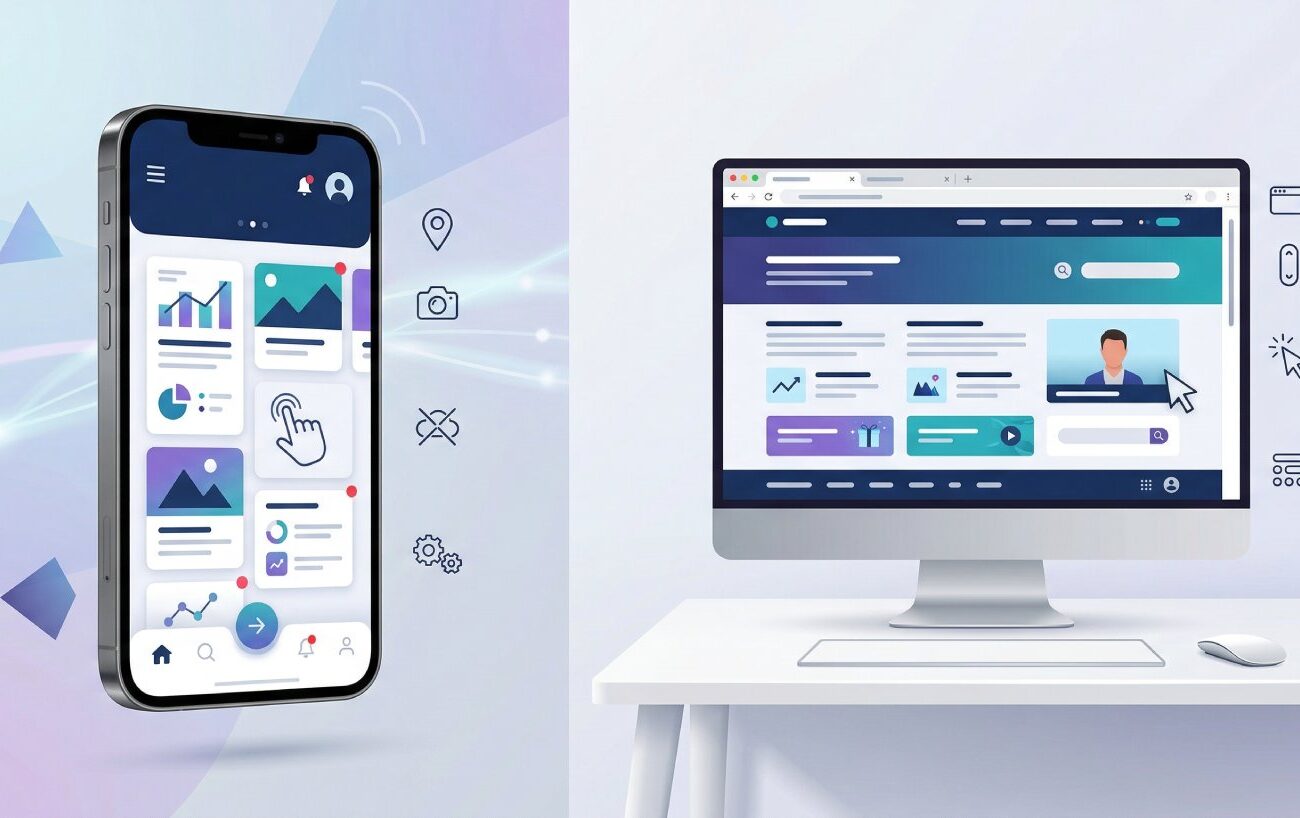
Mobile App vs Website: When Does Your Business Need an App? A lot of digital projects start with a deceptively simple question: should we build an app, a site, or both? The reason this decision feels hard is that it’s not only a design or engineering choice—it’s a distribution choice (how people find you), a behavior choice (how often people use you), and an operations choice (how frequently you can update without friction). That’s why the debate around mobile app vs website remains so common in business planning. From a search and discovery standpoint, the web is still the most universal layer: a link is shareable, indexable, and device-agnostic. Google has explicitly documented that it primarily uses the mobile version of a site’s content for indexing and ranking (mobile-first indexing), which raises the stakes for getting the mobile website experience right. From a retention and “repeat usage” standpoint, mobile apps can create an always-available presence on the home screen, plus deeper operating-system integrations—especially around notifications and device features. At the same time, apps come with platform governance: store policies, review processes, and more structured release management than most websites. This article is written for Ucheed readers and follows an educational lens: definitions, trade-offs, and decision criteria you can apply to your own roadmap. Ucheed publishes a broad suite of digital services (web, mobile, e-commerce, and more), so the most useful guidance is the kind that helps you choose the right delivery model for your users—not the trendiest one. Understanding the difference between mobile app and website Before you can decide mobile app vs. website, you need to define what you mean by “app” and “website,” because teams often mix multiple categories into one comparison. The difference between mobile app and website is not only “installed vs not installed.” It includes distribution, capabilities, update mechanics, and the user’s expectations about what will happen when they tap an icon. A website is delivered through the browser and accessed by URL. A key modern baseline is a “responsive website,” meaning the layout adapts across screen sizes using design and engineering patterns such as fluid grids and media queries—popularized as responsive web design. In real conversations about mobile app vs responsive website, this matters because a truly high-quality responsive site can meet the needs of many businesses without creating “download friction.” A mobile app (in most business contexts) means a platform-specific application distributed through app stores and installed on the device. That distribution model is not neutral: Apple maintains App Store Review Guidelines and reviews apps and updates submitted to App Store Connect, and Google provides a structured “prepare for review” workflow for Play submissions. Those requirements shape timelines, QA, privacy disclosures, and release planning—so they are part of the difference between mobile app and website in practice. Then there is the middle ground: progressive web apps (PWAs). The web platform has evolved to support experiences that feel “app-like” while still running in a browser. MDN describes a PWA as built with web technologies but providing an experience similar to a platform-specific app: it can be installable, can work offline and in the background, and can integrate with device capabilities (within platform limits). Web.dev also emphasizes that a PWA can be installable and reach many devices from a single codebase. This middle ground often changes the framing of mobile app vs. website because it introduces a third option. One concrete PWA capability is offline resilience. MDN explains that offline operation is enabled by adding a service worker; service workers can take control of network requests, serve cached responses, and improve reliability under weak connectivity. This is a practical consideration in mobile app vs responsive website decisions for users who travel, work in the field, or operate in low-signal environments. So the difference between a mobile app and a website can be summarized this way: websites are optimized for reach and instant access; apps are optimized for repeat usage and deeper device integration; PWAs aim to combine parts of both, but with platform constraints that you must plan for. Mobile app vs website for business decision factors If you’ve ever asked “mobile app vs website which is better?” you’ve asked a natural question—but it’s incomplete. Better for acquisition, better for retention, better for time-to-market, or better for long-term cost of ownership? The more actionable framing is: in this mobile app vs website for business scenario, what user behavior are we trying to optimize? A framework that works across industries is to evaluate five decision factors. Put simply, these factors determine when to build a mobile app vs website. Use frequency and urgency. If a user needs your product once in a while—reading content, checking hours, browsing services—a mobile-optimized website usually wins because it’s one tap away through search, social, or a saved link. If a user needs the product daily or weekly, speed of access matters, and a mobile app may reduce friction because it can be launched from the home screen with fewer steps. This frequency test is often the fastest way to clarify mobile app vs website for business decisions. Device capability requirements. If your experience depends on device features (camera capture, location routing, background processing), an app is often simpler to deliver reliably across OS versions. Android’s documentation shows how sensitive data and restricted actions are governed by permission types, including runtime permissions that must be requested at the moment of use—so your UX must be designed around trust and transparency. The more “device-dependent” your product, the more likely it is that when to build a mobile app vs website points toward app-first or app-plus-web. Re-engagement and notifications. Many teams assume notifications automatically decide mobile app vs website which is better, but it’s more nuanced. PWAs can use Push and Notifications APIs (with service workers) in supporting environments. Apple’s WebKit and Safari release notes explain that iOS and iPadOS added support for Web Push notifications for web apps saved to the home screen—meaning the user must install the PWA
Website Cost in Lebanon: Your Guide To Avoid Hidden Fees

How Much Does a Professional Website Cost in Lebanon? In today’s rapidly evolving digital economy, establishing a robust online presence is no longer an optional luxury for businesses; it is a fundamental requirement for survival and growth. As companies across the Levant transition their operations to the digital realm, one of the most pressing questions posed by decision-makers and entrepreneurs is regarding the financial investment required. Specifically, the question of the exact website cost Lebanon dominates boardroom discussions and initial consultations with digital experts. However, asking for the exact website cost Lebanon without defining the scope of the project is akin to asking a real estate developer the cost of building a house without specifying whether it is a small cabin or a multi-story commercial complex. The cost of creating a website in Lebanon is highly variable, influenced by a multitude of factors ranging from the complexity of the design and the underlying technology stack to the level of custom functionality and post-launch support required. This comprehensive guide aims to demystify the financial architecture of digital development. We will dissect the various components that contribute to the overall pricing structure, explore the differences between various platforms, and highlight the critical factors that separate a generic digital brochure from a high-performing digital asset. By understanding these nuances, business leaders can make informed decisions, align their budgets with their strategic goals, and ultimately maximize their digital ROI. The Foundations: Understanding the Scope of Your Digital Project Before a reputable web development agency Lebanon can provide an accurate quotation, a thorough discovery phase must take place. This phase determines the exact requirements of the business and dictates the technological path forward. The baseline website cost Lebanon is fundamentally tied to what the website is expected to do. Is the website merely meant to act as a digital business card, displaying contact information and a brief overview of services? Or is it a complex, transactional platform designed to process thousands of daily orders, manage inventory, and integrate seamlessly with backend Enterprise Resource Planning (ERP) software like Odoo? When evaluating professional website design Lebanon, it is crucial to understand that the visual aesthetic is only the tip of the iceberg. The underlying architecture, database design, user experience (UX) mapping, and security protocols require significant engineering hours. Therefore, the cost of creating a website in Lebanon must be viewed as an investment in digital infrastructure rather than a simple marketing expense. Categorizing Digital Solutions and Their Pricing Structures To provide clarity on the website cost Lebanon, it is helpful to categorize digital projects into distinct tiers based on their complexity and purpose. 1. Corporate and Informational Websites For businesses that provide B2B services, consultancies, or local brick-and-mortar stores, an informational website is often the starting point. These websites focus on establishing brand credibility, generating leads through contact forms, and providing essential corporate information. Many agencies offer standardized business website packages Lebanon for this tier. These packages typically include a set number of pages (e.g., Home, About Us, Services, Blog, Contact), responsive design for mobile devices, and basic contact form integration. When utilizing standard platforms, the WordPress website cost Lebanon for a basic corporate site is generally the most accessible entry point. WordPress allows for rapid deployment and easy content management. However, even within this tier, the professional website design Lebanon standards dictate that the site must not be a mere template copy; it requires customized UI/UX to reflect the brand’s unique identity, which influences the final price. 2. E-Commerce Platforms The transition from an informational site to a digital storefront introduces a significant leap in complexity. The e-commerce website price Lebanon is determined by the specific requirements of the online retail operation. Building a standard e-commerce store with a few dozen products using platforms like WooCommerce or Shopify involves setting up product catalogs, shopping carts, and basic local payment gateways (like Areeba or NetCommerce). However, as the retail operation scales, the e-commerce website price Lebanon increases. Complex e-commerce requirements might include: Multi-Vendor Marketplaces: Allowing third-party sellers to list their products, requiring complex commission splitting and vendor dashboards. B2B Commerce: Implementing specialized pricing tiers, bulk order discounts, and customized quotation request systems. ERP Integration: Connecting the front-end storefront with backend systems like Odoo to ensure real-time inventory synchronization, automated accounting, and logistics management. Because of these highly variable features, the e-commerce website price Lebanon must be carefully scoped by a specialized web development agency Lebanon to ensure that the platform can handle peak traffic and complex transactional data securely. 3. Custom Web Applications and Portals When a business’s operational logic cannot be accommodated by standard content management systems or out-of-the-box e-commerce platforms, custom engineering is required. This is where the custom website development cost comes into play. Custom development involves building tailored web apps and Software as a Service (SaaS) platforms from the ground up, often utilizing robust frameworks like Node.js for the backend and React.js for the frontend, coupled with a customized MySQL database. Examples include: Custom booking engines for the travel or hospitality industry. Tailored Customer Relationship Management (CRM) portals. Complex automation systems designed to streamline specific internal workflows. The custom website development cost is inherently higher because it requires extensive architectural planning, API development, and rigorous quality assurance testing. The software is built specifically to map to the company’s unique DNA, providing a competitive advantage that generic software cannot match. The Platform Debate: WordPress, Odoo, and Custom Stacks The technology stack chosen by your web development agency Lebanon significantly impacts both the initial development investment and the long-term total cost of ownership. The Economics of WordPress The WordPress website cost Lebanon is highly variable. Because WordPress is an open-source platform with a massive ecosystem of plugins and themes, the initial barrier to entry can be relatively low. Standard business website packages Lebanon often utilize WordPress because it provides a familiar, user-friendly dashboard for content updates. However, relying heavily on third-party plugins to achieve complex functionality can lead to technical debt. The WordPress website
WordPress vs Odoo Websites: Which Is Better for Your Business?
WordPress vs Odoo Websites: Unlock True Scale The digital landscape has evolved significantly over the past decade. A website is no longer merely a static digital brochure; it is the operational hub of a modern enterprise. It serves as a storefront, a lead generation engine, a customer service portal, and a brand ambassador. As businesses recognize this shift, the technology stack chosen to build and maintain this digital real estate becomes a critical strategic decision. Among the most prominent debates in the boardroom of growing companies is the choice between two titans of the web: the ubiquitous content management system and the comprehensive business suite. Specifically, the evaluation of WordPress vs Odoo Websites has become a central point of discussion for decision-makers. Choosing the right platform is not simply a matter of aesthetic preference. It is a decision that impacts operational efficiency, data security, marketing agility, and long-term financial overhead. As the market floods with various Open source website platforms, the distinction between a system designed primarily for content publishing and a system designed for holistic business management becomes paramount. This comprehensive guide serves to demystify this complex technological choice. We will conduct a rigorous evaluation of both platforms, examining their core architectures, their capabilities in handling complex e-commerce, their approach to scalability, and their long-term viability for different business models. By exploring the nuances of WordPress vs Odoo Websites, organizations can make an informed, data-backed decision that aligns perfectly with their operational trajectory and digital transformation goals. The Foundations of Open Source Website Platforms Before diving into a feature-by-feature analysis, it is essential to understand the underlying philosophies that birthed these two distinct Open source website platforms. Their origins heavily influence their current capabilities and their ideal use cases. The WordPress Philosophy: Democratizing Publishing WordPress began its life in 2003 as a simple blogging platform. Its core mission was to democratize publishing, making it easy for anyone to share content online without needing to understand complex coding. Over the years, thanks to a massive global community and an expansive ecosystem of themes and plugins, it evolved into the world’s most popular Content Management System (CMS). Today, it powers over 40% of all websites on the internet. Its strength lies in its flexibility, its vast library of third-party extensions, and its unparalleled dominance in traditional content management. The Odoo Philosophy: Unified Business Management Odoo, conversely, did not begin as a website builder. It started as an Enterprise Resource Planning (ERP) system a suite of business applications designed to manage accounting, inventory, manufacturing, and human resources. The website module was introduced later, built directly on top of this robust, data-centric foundation. Therefore, an Odoo website is fundamentally an extension of a company’s internal operations facing the public. Its primary strength is native unification; it eliminates data silos by ensuring that the front-end website and the back-end business logic are part of the exact same system. Understanding this foundational difference is the key to navigating the WordPress vs Odoo Websites debate. One is a CMS that can be extended to handle business functions; the other is a business management system with a native CMS attached to it. A Deep Dive: Content Management Systems Comparison When evaluating the day-to-day usability for marketing teams and content creators, a thorough Content management systems comparison is required. Both platforms offer robust tools for creating pages, publishing blog posts, and managing digital assets, but their approaches differ significantly. WordPress: The Industry Standard for Content In any Content management systems comparison, WordPress is the benchmark. Its administrative dashboard is universally recognized. With the introduction of the Gutenberg block editor, WordPress allowed for more dynamic layout creation directly within the backend. Furthermore, for marketing teams heavily focused on Search Engine Optimization (SEO), WordPress is incredibly powerful. Plugins like Yoast or RankMath provide granular, page-by-page control over meta descriptions, schema markup, and readability scores. For organizations whose primary digital strategy revolves around high-volume publishing, media distribution, or complex editorial workflows, WordPress remains an incredibly compelling choice. The platform is designed specifically to categorize, tag, and distribute written and visual content efficiently. Odoo: Inline Editing and Front-End Focus Odoo takes a different approach to content management. Rather than utilizing a separate backend dashboard for content creation, it heavily utilizes inline editing. Users can navigate to the front-end of their website, click “Edit,” and type directly onto the page, dragging and dropping elements exactly where they want them to appear. This “What You See Is What You Get” (WYSIWYG) approach is highly intuitive for users who may not be technically proficient. While Odoo’s SEO capabilities are strong out-of-the-box (automatically handling URL routing, meta tags, and sitemaps), it may lack the granular, third-party plugin depth that hardcore SEO specialists are accustomed to in WordPress. However, for standard corporate websites and landing pages, Odoo provides a remarkably streamlined and efficient content management experience. Building the Interface: Custom WordPress Development vs. Odoo Website Builder The methodology used to actually construct and design the website is another critical differentiator in the WordPress vs Odoo Websites discussion. Businesses must weigh the value of bespoke coding against the speed of integrated site-building tools. The Ecosystem of Custom WordPress Development WordPress offers limitless design possibilities, but achieving a truly unique, high-performance site generally requires Custom WordPress development. While there are thousands of pre-built themes available, relying on generic themes often leads to bloated code and slower load times. When organizations invest in professional Custom WordPress development, developers build bespoke themes from scratch using PHP, HTML, CSS, and JavaScript. This ensures the website is highly optimized, secure, and perfectly tailored to the brand’s visual identity. Furthermore, custom development allows for the creation of unique post types (e.g., portfolios, real estate listings) and complex logic that off-the-shelf themes cannot accommodate. The trade-off is time and technical debt; maintaining a custom-coded architecture requires ongoing technical expertise. The Efficiency of the Odoo Website Builder On the other side of the spectrum is the Odoo website builder. Odoo’s website module is heavily reliant
Hiring a development agency: The Essential Guide to Success

Hiring a Development Agency in Lebanon: Our Guide In the increasingly interconnected global economy, the search for technological excellence has transcended geographical boundaries. Businesses, ranging from burgeoning startups to established multinational enterprises, are constantly seeking reliable partners to navigate the complexities of the digital age. One destination that has emerged as a significant hub for technical talent is Lebanon. For decision-makers, Hiring a development agency in this region offers a unique convergence of skilled human capital, cost-efficiency, and cultural alignment with Western markets. The process of Hiring a development agency is a pivotal moment in a company’s trajectory. It is not merely about procuring code; it is about selecting a partner capable of translating abstract business goals into tangible digital assets. As the demand for sophisticated digital solutions grows, understanding the nuances of the Lebanese tech landscape becomes essential for any organization looking to leverage this talent pool. This guide provides a comprehensive overview of the factors involved in selecting the right partner, ensuring that your investment yields sustainable growth and competitive advantage. The Strategic Appeal of the Lebanese Tech Sector Lebanon has historically been a crossroads of culture and commerce, a trait that has seamlessly transitioned into the digital realm. The country boasts a highly educated workforce, with a significant percentage of graduates holding degrees in STEM fields. This educational foundation creates a robust environment for Outsourcing IT services to Lebanon, where technical proficiency meets creative problem-solving. The Rise of Nearshore Capabilities For companies in Europe and the Gulf region, Lebanon serves as an ideal location for Nearshore development teams. The time zone compatibility facilitates real-time collaboration, reducing the friction often associated with offshore partnerships. When Hiring a development agency, communication is paramount. The multilingual nature of the Lebanese workforce fluent in Arabic, English, and French ensures that Nearshore development teams can integrate smoothly with client teams, minimizing the risk of misinterpretation that can derail complex projects. Furthermore, Outsourcing IT services to Lebanon allows businesses to access high-caliber talent without the overhead costs associated with maintaining in-house teams in high-cost-of-living countries. This economic efficiency does not come at the expense of quality; rather, it allows for resource reallocation towards other critical business areas like marketing and R&D. Defining Your Project Scope and Needs Before embarking on the journey of Hiring a development agency, it is crucial to have a crystal-clear understanding of your project requirements. The term “development” encompasses a vast array of services, and the Best software development company Lebanon has to offer will typically specialize in specific verticals or offer a comprehensive suite of solutions. Identifying the Right Service Mix Web Development: Are you looking for Web development services Beirut to build a corporate presence or a complex web portal? The requirements for a static informational site differ vastly from a dynamic, data-driven web application. Mobile Solutions: If your audience is primarily mobile, you need specialized Mobile app developers Lebanon who understand the nuances of iOS and Android ecosystems, as well as cross-platform frameworks like React Native. Custom Logic: For unique business processes that off-the-shelf software cannot handle, you will require Custom software solutions tailored to your operational workflows. Understanding these distinctions helps in filtering potential candidates. When you are Hiring a development agency, specificity in your request for proposal (RFP) attracts partners who are genuinely equipped to deliver. Criteria for identifying the Best Partners Finding the Best software development company Lebanon requires a disciplined approach to vetting. The market is populated with numerous players, from freelance collectives to established firms. To identify the Top tech agencies in Beirut, one must look beyond the surface level of marketing claims and evaluate the core competencies of the agency. Technical Proficiency and Architecture A primary indicator of quality is the agency’s approach to Secure software architecture. In an era of increasing cyber threats, security cannot be an afterthought. The Best software development company Lebanon will prioritize security capability maturity, ensuring that code is written with robust encryption, secure authentication protocols, and compliance with international data protection standards. When Hiring a development agency, inquire specifically about their security practices and how they integrate Secure software architecture into their development lifecycle. Portfolio and Track Record The portfolios of Top tech agencies in Beirut should demonstrate a diversity of successful projects. Look for case studies that mirror the complexity of your own needs. Have they delivered Custom software solutions for enterprise clients? Have they executed large-scale e-commerce projects? A proven track record is the most reliable predictor of future success. Specialized Expertise: Web, Mobile, and Commerce Different projects require different sets of expertise. A generalist approach may suffice for basic needs, but competitive advantage often requires specialists. The Role of Professional Website Builders For businesses focusing on their digital storefront, Professional website builders play a critical role. These are not just coders but designers and UX specialists who understand how to convert visitors into customers. Web development services Beirut are renowned for their aesthetic sensibility combined with technical rigor. Whether utilizing a CMS or building from scratch, Professional website builders ensure that the final product is responsive, SEO-friendly, and visually compelling. E-commerce Development Experts The retail landscape is shifting online, and E-commerce development experts are in high demand. Building an online store involves complex integrations of payment gateways, inventory management systems, and logistics APIs. When Hiring a development agency for retail, ensure they have specific experience in this domain. E-commerce development experts in Lebanon are adept at platforms like WooCommerce and Shopify, as well as building bespoke commerce engines that handle high transaction volumes securely. Mobile App Developers Lebanon The ubiquity of smartphones makes mobile presence non-negotiable for many brands. Mobile app developers Lebanon are recognized for producing high-performance applications that offer seamless user experiences. Whether it is a consumer-facing loyalty app or an internal business tool, the proficiency of Mobile app developers Lebanon in using modern frameworks allows for rapid deployment and easy maintenance. The Financial Perspective: Cost vs. Value One of the most common questions when Hiring a development