
AI SEO Services: How GEO and AEO are Redefining Search in the MENA Region
The global search landscape is currently experiencing its most profound structural realignment since the introduction of the first ranking algorithms. In the Middle East and North Africa (MENA) region, this shift is not merely a technical evolution but a cultural and economic transformation driven by a rapid surge in artificial intelligence literacy and the integration of Large Language Models (LLMs) into the daily fabric of digital life. For businesses operating in high-growth markets like the UAE, Saudi Arabia, and Lebanon, the transition from traditional search engine optimization to a sophisticated framework of ai seo services is the only path to remaining relevant. As discovery moves away from the “ten blue links” model toward synthesized, conversational answers, the company ucheed stands as a pivotal architect for brands seeking to “Be the Number One” in an environment where visibility is increasingly mediated by AI agents.
The emergence of generative engine optimization (GEO) and Answer Engine Optimization (AEO) has fundamentally altered the criteria for digital authority. While traditional search engine optimization focused on technical health and keyword relevance, the future of seo is defined by a brand’s ability to be cited as a trusted source within AI-generated responses. This report examines the multidisciplinary strategies required to dominate this new landscape, focusing on the intersection of technical engineering, semantic content architecture, and the unique linguistic nuances of the MENA region.
The Paradigm Shift: From Link Discovery to Information Synthesis
For over two decades, the relationship between search engines and content creators was defined by a deterministic model of keyword matching. Users entered a query, and the engine provided a list of ranked links. Today, this model is being superseded by a probabilistic approach where the engine increasingly an LLM synthesizes information from multiple sources to provide a direct answer. This shift, often described as “The Great Decoupling,” signifies the gap between rising brand impressions in AI summaries and the potential for declining traditional click-through rates.
In the MENA region, particularly in the UAE and Saudi Arabia, the adoption of AI tools has outpaced global averages. In 2025, search trends revealed a massive surge in literacy, with Google Gemini, DeepSeek, and ChatGPT topping technology search lists. This indicates that the consumer is no longer just looking for a website; they are looking for an answer. For a business to succeed, its content must be structured not just for indexing, but for extraction. This is the core mandate of ai seo services: ensuring that a brand’s intellectual property is machine-readable, factually dense, and authoritative enough to be the primary citation in an AI Overview.
The Evolution of the Three-Layered Search Strategy
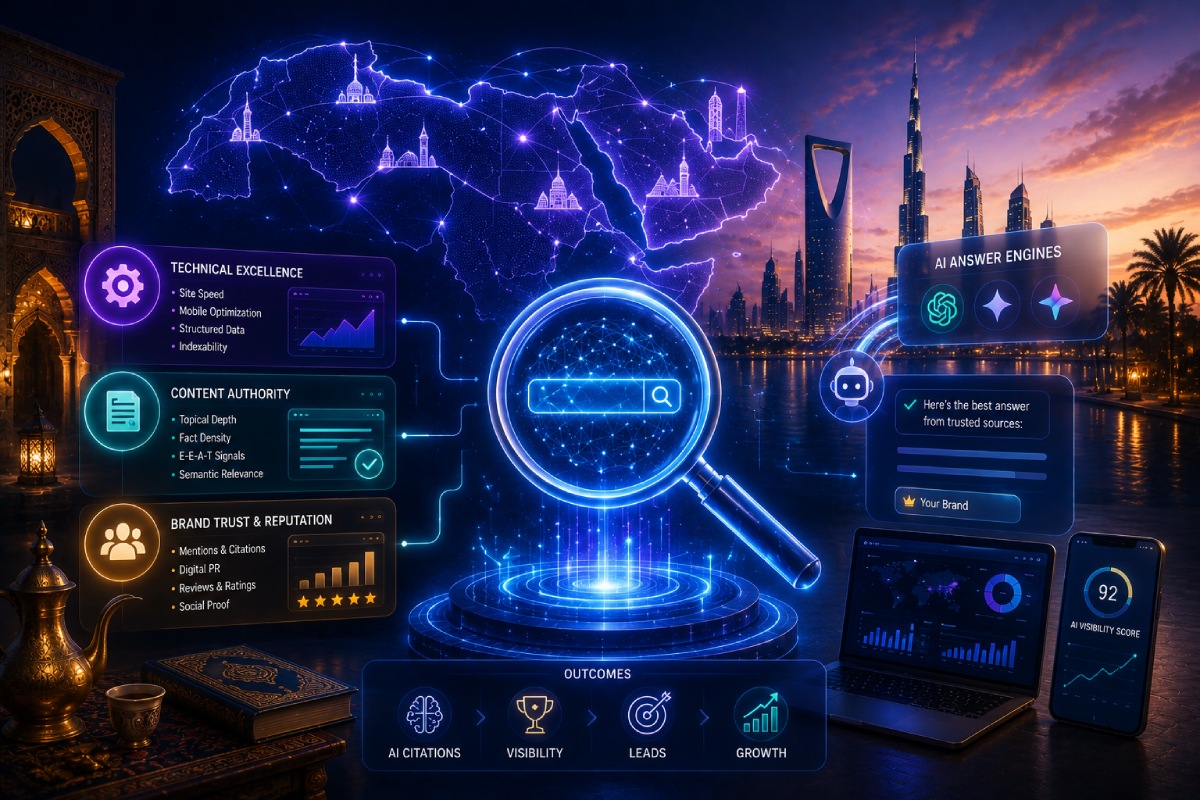
The modern approach to visibility is a complementary, three-layer strategy that builds upon the foundations of traditional web standards while optimizing for the synthetic era. Each layer serves a distinct purpose in the user’s journey from discovery to conversion.
| Strategy Layer | Primary Objective | Mechanism | Outcome |
| Search Engine Optimization | Establish baseline visibility and site health | Keywords, Backlinks, Technical Health | Ranking in standard organic results |
| Answer Engine Optimization (AEO) | Capture direct, answer-first search features | FAQ Schema, Scannable Answer Blocks | Presence in SGE, Featured Snippets, Voice |
| Generative Engine Optimization | Secure brand citations in LLM syntheses | Fact Density, Authority Signals, Wiki-Tone | Being recommended by ChatGPT, Claude, Gemini |
As ucheed articulates, the goal is not merely to compete but to stand out by securing the top spot across all three layers. This requires a proactive and informed approach that moves beyond the basics of search engine optimization and into the intricate workings of modern algorithms.
The Science of Generative Engine Optimization
Generative engine optimization is the process of optimizing content to maximize the probability of being selected by an LLM during the answer generation process. Unlike traditional search, which uses an index, GEO targets the weights and biases of probabilistic models. These models predict the next word in a sequence based on statistical likelihood; therefore, content must be formatted to lower the model’s “perplexity” the measure of uncertainty when selecting a source.
Fact Density and the “Wiki-Voice” Tone
One of the most revolutionary findings in recent SEO research is the impact of “Fact Density.” A study from Princeton University demonstrated that including authoritative citations, statistics, and direct quotations can boost a website’s visibility in generative responses by up to 40%. For a brand, this means moving away from vague marketing copy such as “our services are the best in the industry” and toward neutral, objective, and verifiable claims, such as “our framework has been adopted by 78% of the top 500 regional enterprises according to a 2025 audit”.
This adoption of a “Wiki-Voice” a neutral, encyclopedic tone is essential for chatgpt seo. LLMs are risk-averse; they favor sources that mimic the style of their training data, which heavily features scholarly and factual content. When content is written in academic prose with an “Inverted Pyramid” structure, it is computationally cheaper for the model to process, rephrase, and cite.
The Consensus Factor and Third-Party Platforms
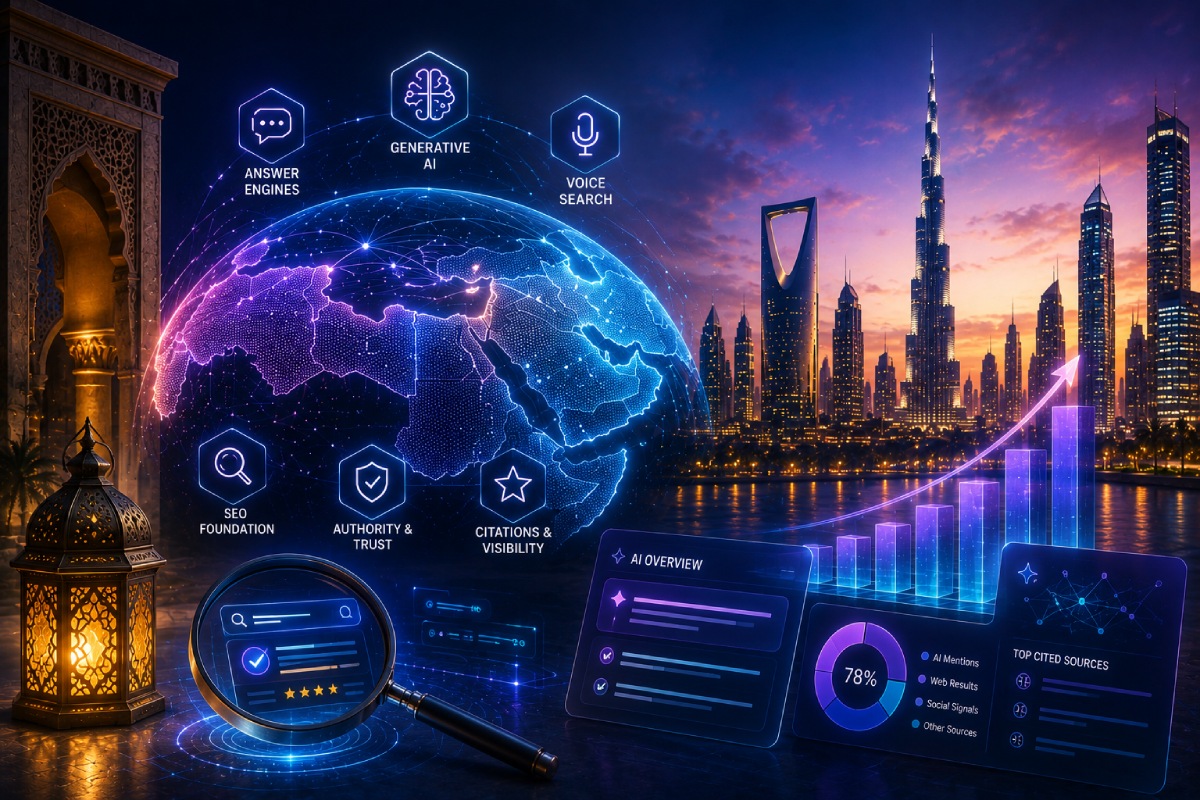
AI models do not exist in a vacuum; they verify facts by checking for consensus across multiple sources. This makes off-site signals more critical than ever. Mention volume on platforms like Reddit and Quora correlates with a 4x increase in citations, as these platforms serve as “human reinforcement” for the AI’s probabilistic guesses. For businesses in Beirut or Dubai, ai search visibility depends on being part of the conversation on these community-driven sites. This is where ucheed‘s architectural approach to search proves its value, as it builds authority both on and off the primary domain.
Answer Engine Optimization and the Rise of AI Overviews
AEO is the practice of formatting content for AI search features like Google’s AI Overviews (formerly SGE), Bing Copilot, and Perplexity’s instant answers. In the MENA region, the expansion of AI Overviews in May 2025, including full support for Arabic and Turkish, has created a new frontier for ai overview optimization.
Structuring Content for Extraction
To succeed in AEO, content must be “extraction-friendly.” This involves packaging information in clear blocks of 40–60 words, which align with the typical size of an AI response paragraph. The use of question-based headings (H2s and H3s) that mirror real user queries is a baseline requirement. When an engine scans a page and finds a clean, authoritative answer to a specific “how” or “why” question, that page becomes a prime candidate for a featured summary.
| AEO Extraction Tactic | Implementation Requirement | Benefit for AI Search Visibility |
| Answer-First Structure | Lead with the “Bottom Line Up Front” (BLUF) | Increases likelihood of being the primary overview snippet |
| Structured Listicles | Use bullet points for processes and features | Improves scannability for AI agents and human users |
| Comparison Tables | Provide direct product/service comparisons | Dominates “best of” or alternative search queries |
| FAQ Schema | Implement JSON-LD for every Q&A section | Provides a hard-coded truth layer for AI engines |
AEO ensures that content is hyper-aligned with the intent behind a search, focusing on clarity, relevance, and immediate usefulness. This is particularly important for mobile-first users in the MENA region, who often use voice search to ask conversational questions like “What is the best ai seo services provider for small businesses in Lebanon?”.
Technical Foundations for AI SEO Services
No amount of high-quality content can succeed if the website’s underlying architecture is invisible to AI crawlers. In the Lebanese market, where internet speeds can vary significantly, technical performance is a competitive necessity. A professional audit by ucheed prioritizes Core Web Vitals, ensuring that Largest Contentful Paint (LCP) is under 2.5 seconds and Interaction to Next Paint (INP) is less than 200 milliseconds to avoid perceived lag.
Server-Side Rendering and Crawler Access
AI crawlers, such as GPTBot, ClaudeBot, and PerplexityBot, do not always execute JavaScript with the same fidelity as a human browser. If a website relies heavily on client-side rendering (React, Vue, etc.), the content might appear as an empty page to the bot. AI seo services must ensure that the server returns a complete HTML document (Server-Side Rendering) for all critical text and data. Furthermore, many sites inadvertently block AI bots through misconfigured robots.txt files or CDN settings (like Cloudflare’s default AI-blocking rules). Regular log audits are necessary to confirm that agents like “ChatGPT-User” are successfully visiting and indexing the site.
The Role of Schema and the llms.txt Directory
Schema markup serves as a standardized bridge between a website and an AI. By using MedicalClinic, Physician, and FAQPage schema, businesses provide search engines with structured, unambiguous data that reduces the probability of hallucination. A forward-looking trend in 2026 is the implementation of an /ai or llms.txt directory a machine-readable “front door” that allows AI agents to instantly grasp a business’s core information without parsing the entire visual layout. This is a critical component of seo for chatbots, preparing brands for a web where discovery is mediated by digital assistants.
The MENA Region: A Unique Linguistic and Cultural Context
The MENA search landscape is defined by its linguistic diversity and high mobile engagement. In the UAE, 99% of residents own a smartphone, and over 54% of Google searches are conducted in Arabic. This makes mobile-first optimization and local cultural relevance non-negotiable.
Semantic Search Lebanon: Navigating Trilingualism
Lebanon presents a unique challenge where users fluidly transition between Arabic, French, and English, often within the same query. A successful semantic search lebanon strategy involves more than just translation; it requires a granular understanding of search intent across languages.
- Arabic: Dominates hyper-local services, daily consumer goods, and news.
- English: Preferred for B2B services, technology, and medical research.
- French: Used for formal communication, legal, and professional terminology.
Furthermore, the use of “Arabizi” the Latinized Arabic alphabet is widespread in informal mobile queries. A robust ucheed strategy involves manually crafting localized metadata and implementing Hreflang tags to ensure search engines serve the correct language version to the right user, capturing search patterns that generic agencies might miss.
Regional AI Adoption and Search Trends
The surge in AI literacy in the MENA region has transformed the competitive landscape. In 2025, the UAE emerged as a global leader in AI diffusion, while Saudi Arabia showed a deep thirst for future-tech tools like Google Gemini and Hailuo AI.
Prefer our answers? Set ucheed.com as a preferred source on Google — takes two taps, signed-in Google users only.
| Country | Top AI/Tech Search Trends (2025) | Notable Local Digital Transformation |
| UAE | Gemini, DeepSeek, ChatGPT, Veo | Global hub for AI-driven image and video creation |
| Saudi Arabia | Gemini, Hailuo AI, Qobool | Rapid digitization of public and educational services |
| Lebanon | Digital ID, AI-driven Healthcare, Trilingual SEO | National Digital Health Strategy 2025–2030 |
| Morocco | BlackBox AI, Claude, Manus | Sophisticated interest in developer-focused AI tools |
This environment rewards brands that are proactive in their ai seo services adoption. In a region where seasonal spikes like Ramadan and the Dubai Shopping Festival can 3-5x search volume overnight, the ability of AI models to adapt in real-time to trending queries is a vital advantage.
Industry-Specific Applications: Healthcare and Ethics
The medical sector is a primary beneficiary of ai seo services, but it is also the most heavily regulated. In Lebanon, the Ministry of Public Health (MoPH) is leading a National Digital Health Transformation Strategy (2025–2030), emphasizing e-health, AI-driven decision-making, and transparency.
E-E-A-T in the YMYL Category
Medical content is categorized as “Your Money or Your Life” (YMYL), meaning it must meet the highest standards of Experience, Expertise, Authoritativeness, and Trustworthiness. To appear in an AI Overview for a medical query, a clinic must:
- Demonstrate Verifiable Experience: Use clinician bios that include licensing context and hospital affiliations.
- Cite Reputable Sources: Link to clinical studies, the MoPH Lebanon, or international health bodies.
- Ensure Clinician Review: Every piece of AI-generated content must be audited by a human expert to prevent dangerous “hallucinations”.
Ethics, Privacy, and Accuracy
Accuracy is not just an SEO requirement; it is an ethical mandate. AI-generated documentation can misinterpret context or generate overconfident clinical narratives, posing safety risks. Furthermore, data privacy laws like HIPAA (internationally) and Lebanon’s evolving digital governance require that patient information is never exposed in public AI prompts. For a healthcare provider, the future of seo lies in being a “transparent actor,” as transparency itself becomes a form of protection in the pharmaceutical and medical sectors.
Measuring Success: The New KPIs for the AI Era
Traditional metrics like rankings and organic traffic are no longer sufficient to measure the impact of a comprehensive organic growth strategy. Success in the age of synthetic search must be measured by a brand’s “Share of Model” (SoM) and its citation frequency within AI platforms.
Tracking “Share of Model” and Citation Rates
Since there is no “ChatGPT Search Console,” businesses must use specialized ai seo services tools to monitor their visibility across ChatGPT, Gemini, and Perplexity. This involves logging how often a brand is cited for its core keywords and comparing that data to competitors.
$$Citation Rate = \frac{Total Queries with Brand Mention}{Total Queries in Category}$$
Tracking this data allows Ucheed to identify which content blocks are being interpreted and shared by AI agents, enabling continuous refinement of the content architecture.
GA4 and the Organic AI Channel
To quantify the traffic that does click through from AI platforms, a custom channel group in GA4 is essential. By creating a specific rule for sources like chatgpt.com, perplexity.ai, and gemini.google.com, marketers can see the real growth of this emerging source and measure its conversion rate, which Semrush reports can be up to 4.4x higher than traditional search traffic.
The Road to 2030: Preparing for the Agent-Mediated Web
As we look toward the future of seo, it is clear that we are moving into an “agent-mediated” web. In this environment, AI agents will handle the initial research, comparison, and even purchasing decisions for both B2B and B2C customers.
- API Accessibility: Technical accessibility will become more critical than visual readability, as agents interact with data through standardized API calls.
- Owned Audiences: As AI intercepts more top-of-funnel traffic, building direct communication channels newsletters, SMS, and community groups becomes a survival strategy.
- Human Connection: Brands must provide the emotional resonance and community-building elements that AI cannot replicate, ensuring a “Dual-Value Proposition” for both machines and humans.
In Lebanon, the National Digital Transformation and AI Strategy 2025–2030 aims to position the country as a regional hub for innovation, with the goal of AI contributing 10% of the national GDP by 2030. For businesses, this means the window to optimize for AI search is open now. Delaying the transition to ai seo services means ceding ground to competitors who are already engineering their digital authority.
Frequently Asked Questions
-
How is generative engine optimization different from traditional SEO?
Traditional search engine optimization focuses on ranking in the “blue links” of search engines through keywords and backlinks. GEO focuses on making your content the most authoritative source for AI models so that they cite your brand when synthesizing answers for users in platforms like ChatGPT and Gemini.
-
Why is semantic search lebanon so complex for businesses?
Lebanon’s search behavior is trilingual (Arabic, English, French) and includes “Arabizi” patterns. A generic approach fails because search intent changes by language; for example, a user might use English for research but switch to Arabic for local transactions. Ucheed solves this by architecting content that addresses intent across all three linguistic layers.
-
What is “Fact Density,” and how does it help chatgpt seo?
Fact Density is the inclusion of specific, verifiable data, statistics, and citations in your content. LLMs are risk-averse and prefer to cite sources that are factually rich and written in a neutral, “Wiki-Voice” tone. Increasing fact density can boost your visibility in AI responses by up to 40%.
-
Will ai overview optimization reduce my website traffic?
While AI Overviews can lead to “zero-click” searches for simple queries, they also lead to higher-quality engagement. Users who find your brand through an AI citation often have stronger purchase intent and convert at a significantly higher rate than traditional search visitors.
-
What are the top technical priorities for ai seo services in 2026?
The priorities include ensuring Server-Side Rendering (SSR) so bots can read your content, implementing comprehensive Schema Markup to provide “hard-coded truths,” and optimizing Core Web Vitals to meet the speed requirements of mobile-first users in the MENA region.
-
Can I use AI to write all my SEO content?
AI can be a powerful tool for ideation and outlining, but human oversight is mandatory for accuracy and brand resonance. In YMYL (Your Money or Your Life) sectors like healthcare, unedited AI content can lead to “hallucinations” that damage trust and result in penalties from search engines.
-
How does Ucheed help businesses “Be the Number One” in AI search?
Ucheed provides a “full-stack” deliverable set that spans technical engineering, semantic content architecture, and trilingual strategy. By focusing on architectural excellence rather than basic rankings, Ucheed ensures your brand builds sustainable digital authority that survives algorithm updates and excels in AI search.
-
How do I track my visibility in AI search engines?
You can measure success by tracking your “Share of Model” (SoM) and citation frequency. In GA4, you should set up a custom channel group to specifically monitor traffic originating from AI sources like chatgpt.com and perplexity.ai.
Conclusion: Securing the Future of Digital Authority
The transition to an AI-first search landscape is an existential challenge for businesses that remain tethered to outdated ranking models. In the MENA region, where technology and tradition intersect, the companies that will lead are those that recognize discovery is now an extracted and synthesized experience. By adopting a comprehensive framework of ai seo services, businesses can transform their digital presence from a series of links into a cited authority.
As Ucheed maintains, dominance in the digital sphere is not about a one-time fix but about consistent execution against a well-defined organic growth strategy. From the technical foundations of SSR and schema to the semantic nuances of trilingual search, every element of a brand’s presence must be optimized for both the human user and the AI agent. In a market as dynamic as the Levant and the wider Gulf, being the number one choice means being the source that the machines and the people who use them trust above all others.
Make Ucheed your go-to source on Google.
Google now lets you pick your Preferred Sources — the sites you trust most rise to the top of AI Overviews and AI Mode with a "Preferred" label. If our SEO and app-development guides have earned a spot in your search results, add us in two taps. Add ucheed.com as a preferred source →