
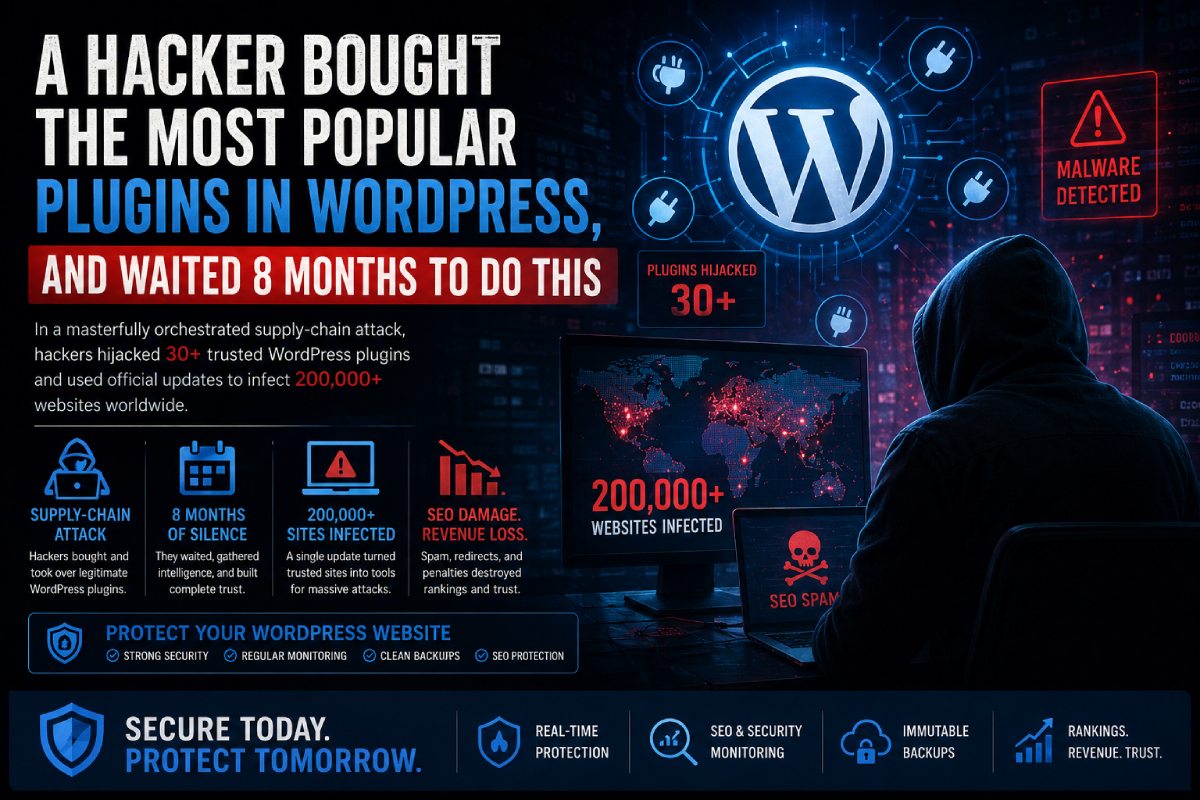
A hacker bought the most popular WordPress plugins, and waited 8 months to do this
The digital landscape of 2026 has witnessed what cybersecurity experts now describe as the “Great Trust Breach.” In a carefully orchestrated supply-chain attack, hackers moved far beyond traditional brute-force methods and exploited the very foundation of the WordPress ecosystem: trust between plugin developers and website owners.
This incident rapidly became known as the latest WordPress attack 2026, raising major concerns about how WordPress sites get hacked and why businesses are investing more heavily than ever in WordPress malware protection to protect WordPress website infrastructure against evolving WordPress security threats.
For most website owners, the consequences were devastating. Years of SEO authority, rankings, and organic traffic disappeared almost overnight. Yet for a smaller group of businesses using Ucheed’s technical SEO maintenance and protection services, the crisis barely caused disruption. While competitors rushed to recover hacked pages and remove malware, Ucheed clients continued climbing search engine rankings without interruption.
In this detailed analysis, we examine the anatomy of the 2026 breach, the direct relationship between cybersecurity and SEO performance, and the strategic architecture that enabled Ucheed to serve as a highly secure fortress for its partners.
The Anatomy of a “Long Con”: How 30+ Plugins Became Weapons
The WordPress attack of 2026 was not a sudden event. It was a patient and calculated operation. The attackers understood that modern WordPress firewalls are increasingly effective at blocking direct intrusions, so they chose a more sophisticated route: legitimate access.
The Acquisition Phase
Beginning in late 2025, several shell companies connected to an international hacking syndicate quietly approached developers of mid-sized WordPress plugins. Their targets included trusted utilities with long histories, excellent ratings, and active installations between 5,000 and 50,000 websites.
These plugins included:
- Image optimization tools
- Lightweight SEO helpers
- Custom CSS utilities
- Performance enhancement plugins
Most developers were independent creators or small teams looking to sell their projects. The purchases appeared completely legitimate. Ownership changed quietly, without public warnings or visible red flags.
The Dormancy and Intelligence Gathering Phase
After acquiring control of these plugins, the attackers avoided suspicious activity. Instead, they released several normal-looking “maintenance updates” that genuinely improved plugin performance. This increased user trust and encouraged site owners to keep automatic updates enabled.
Hidden within these updates was a lightweight “scout” script that quietly collected data, including:
- PHP versions and server configurations
- Administrator usernames and login habits
- Installed security systems
- XML sitemaps and top-performing pages
Most importantly, the malware identified high-traffic pages suitable for SEO spam injection.
The Activation Phase
In early 2026, the hackers triggered a remote “Kill Command” through command-and-control servers. The dormant malware activated simultaneously across thousands of websites.
Core WordPress files such as:
- functions.php
- wp-config.php
were remotely modified. Within hours, more than 200,000 websites became part of a coordinated botnet designed to manipulate search rankings, spread malicious redirects, and distribute harmful content.
The Invisible Threat: Why Traditional Security Failed
The 2026 breach revealed a serious reality: standard WordPress security practices are no longer enough.
Many website owners believed they were protected because they:
- Used strong passwords
- Installed firewalls
- Updated plugins regularly
Ironically, these “safe” habits became the attack vector itself.
Because the malware arrived through trusted plugin updates distributed from official channels, many traditional security systems allowed the code to pass undetected.
The malware also used advanced “Dynamic Cloaking” techniques:
- Website administrators saw normal pages
- Googlebot visitors saw spam content
- Mobile users from search engines were redirected to malicious websites
As a result, site owners remained unaware while their SEO rankings and brand reputation collapsed behind the scenes.
The SEO Massacre: How Hacked Plugins Destroy Revenue
The main objective of the 2026 attack was not website destruction it was authority theft.
Search engine rankings represent digital trust and revenue. By compromising thousands of websites, hackers gained access to billions of dollars in SEO value.
SEO Spam and Manual Penalties
After activation, the malware generated hidden “Shadow Pages” promoting:
- Illegal gambling
- Fake pharmaceuticals
- Cryptocurrency scams
These pages were invisible to normal users but visible to search engines.
Google’s 2026 algorithms, which place stronger emphasis on security signals, quickly detected these manipulative patterns. Many websites received:
- Manual Actions
- Severe ranking drops
- Complete de-indexing
Businesses that spent years building domain authority lost visibility within days.
Mobile-Only Redirects
One of the most dangerous aspects involved mobile-specific redirects.
When smartphone users clicked Google search results, the malware redirected them to phishing websites designed to steal financial information.
Desktop visitors including the website owners themselves often saw no problem at all. This delayed detection for weeks and caused enormous reputational and legal damage.
The Ucheed Shield: Security Through Architecture
While the digital world struggled to recover, Ucheed clients remained protected.
For Ucheed, the 2026 attack validated its “Digital Growth Architect” philosophy: development should focus on growth and resilience, not emergency recovery.

- Minimalist Architecture & Supply-Chain Audits
Unlike agencies that depend on dozens of third-party plugins, Ucheed prioritizes lean custom development.
This dramatically reduces the attack surface.
Many affected plugins were never installed on client websites because their functionality had already been replaced with lightweight proprietary systems.
For essential plugins, Ucheed maintained strict developer monitoring and ownership tracking to identify risky acquisitions before they became threats.
- Real-Time File Integrity Monitoring
Traditional malware scanners run periodically.
Ucheed’s systems continuously monitor file integrity in real time.
The moment malware attempted to alter core files, automated lockdown systems:
- Quarantined infected plugins
- Blocked unauthorized modifications
- Alerted security specialists immediately
The attack was stopped before it could spread.
- SEO Visibility Protection
Search visibility is treated as a business-critical asset.
Ucheed continuously monitors:
- Google Search Console anomalies
- Indexing behavior
- Redirect patterns
- Mobile-specific cloaking attempts
Any suspicious activity triggers instant investigation.
This ensured Google only indexed trusted, high-quality content from Ucheed clients.
- Immutable Backup Infrastructure
Many hacked businesses discovered their backups were infected because the malware remained dormant for months.
Ucheed’s backup architecture uses:
- Off-site storage
- Immutable backup systems
- Automated checksum verification
This guarantees access to clean restoration points even after sophisticated attacks.
Why Technical SEO Maintenance Is Now Revenue Protection
The events of 2026 changed the definition of SEO forever.
SEO is no longer only about:
- Content
- Backlinks
- Keywords
Today, technical security is directly tied to rankings.
Google increasingly prioritizes websites that are:
- Secure
- Fast
- Technically healthy
- Free from malware
Ucheed’s SEO maintenance strategy ensures:
- Rankings remain stable
- Search indexing stays clean
- Organic traffic remains protected
- Visitors are shielded from malicious redirects
In modern SEO, cybersecurity is no longer optional it is part of ranking protection itself.
Warning Signs: Is Your Website at Risk?
The 2026 WordPress breach exposed dangerous weaknesses in many agencies and hosting environments.
Ask yourself:
- Does your website rely on dozens of third-party plugins?
- Are backups stored on the same server?
- Is anyone monitoring file integrity continuously?
- Is your SEO strategy disconnected from security practices?
If the answer is yes, your business may already be vulnerable.
Conclusion: Protect Your Future Before the Next Update
The WordPress attack of 2026 was not an isolated event. It was a clear warning about the future of digital warfare.
Cybercriminals now understand that the easiest way to steal revenue is by weaponizing the very systems businesses trust every day.
In this environment, being “good enough” is no longer enough.
To lead your industry, you need:
- Secure architecture
- Technical SEO expertise
- Continuous monitoring
- Strategic digital protection
At Ucheed, websites are treated as long-term business assets not temporary marketing projects.
We handle:
- Security monitoring
- Technical SEO maintenance
- Infrastructure optimization
- Ranking protection
Therefore, businesses can focus on growth, expansion, and opportunity.
Do not wait for the next plugin takeover.
Do not wait for your rankings to collapse.
Protect your future before the next update arrives.