SEO Services for Saudi Arabia and the Wider GCC: Win Gulf Search

SEO Services for Saudi Arabia and the Wider GCC: Winning Search Beyond Dubai and UAE Search for “SEO Saudi Arabia” and most of what turns up is really just Dubai SEO with a regional label attached. That’s a gap, because Saudi Arabia is the largest market in the Gulf by population and by digital spend — and Riyadh, Jeddah, and the wider Kingdom behave differently in search than Dubai does. Add Qatar, Kuwait, and Bahrain into the mix, and a business trying to rank across the Gulf is really solving four or five distinct search problems, not one. Why SEO Saudi Arabia Is the Gulf’s Biggest Search Opportunity Saudi Arabia’s Vision 2030 push has accelerated e-commerce adoption, digital payments, and mobile-first buying behavior faster than almost anywhere else in the region. That means search demand is growing quickly in categories that didn’t exist as competitive keyword spaces five years ago — and early movers in a given niche are still catching an unusually open field compared to saturated markets like Dubai. What’s different about Saudi and wider Gulf search vs. Dubai/UAE A companion post on Dubai/UAE-specific GCC search dynamics is in the same content batch (not yet published) — once live, cross-link it here. Saudi Arabia and the rest of the Gulf add their own layer on top of that UAE-focused foundation: Dialect and phrasing differences. Saudi Arabic search phrasing (Najdi and Hijazi patterns) diverges from both Lebanese/Levantine Arabic and Emirati Gulf Arabic. Keyword research built for one doesn’t transfer cleanly to the others. A distinct e-commerce and logistics ecosystem. Saudi Arabia has its own dominant payment methods, delivery expectations, and marketplace behavior, which changes what “high-intent” commercial queries look like. The same principle we outline for regional expansion in regional e-commerce strategy across MENA applies directly here: duplicating a UAE strategy into Saudi Arabia without adjusting for local buyer behavior leaves conversions on the table even when rankings look fine. Government-driven digital transformation. Vision 2030 initiatives mean search volume is rising fastest in categories tied to new digital infrastructure, giving well-optimized new entrants room to rank before competition catches up. Qatar, Kuwait, and Bahrain each need their own signals too. Smaller search volumes don’t mean lower competition — in several verticals, the opposite is true, because fewer well-optimized local competitors exist yet. Building one search strategy across multiple Gulf markets Businesses trying to cover Saudi Arabia, UAE, Qatar, Kuwait, and Bahrain from a single generic “Gulf” page consistently underperform. As we’ve argued for cross-border expansion generally in why SEO architecture beats basic rankings tactics, the fix is structural, not cosmetic: Separate, geo-specific landing content per market instead of one blended Gulf page Proper hreflang and internal linking so Google treats each market as distinct, not duplicate Local business and trust signals (reviews, citations, market-specific case studies) built market-by-market AI search is already ahead of the curve in the Gulf Gulf audiences — Saudi Arabia included — are early, heavy adopters of AI-driven search and assistants, which is exactly the shift we detail in beyond rankings: dominating 2026 with AI SEO services. A Saudi or wider-Gulf strategy that ignores generative engine optimization is already behind, not just on trend. How Ucheed delivers SEO services in Saudi Arabia and across the GCC Our SEO services for the GCC cover the wider Gulf, not just Dubai and the UAE — built around the same architecture-first methodology we use across every market we serve, adapted market-by-market rather than copy-pasted across borders. Expanding into Saudi Arabia or the wider Gulf? Get a Gulf market SEO assessment from Ucheed. FAQ Does Ucheed provide SEO services in Saudi Arabia? Yes — Ucheed works with businesses across Saudi Arabia as part of its regional Gulf practice, alongside the UAE, Qatar, and wider GCC. Is SEO different in Saudi Arabia compared to the UAE? Yes — dialect, e-commerce behavior, and market maturity differ enough that a shared Gulf strategy needs market-specific execution, not one blended approach. Should a business active in Dubai also target Saudi Arabia in the same campaign? Only with dedicated Saudi-specific content and technical setup (hreflang, local signals) — treating Saudi as an extension of a UAE campaign without adjustment typically underperforms. What does an SEO Saudi Arabia engagement typically cost, and how fast do results show? Pricing depends on how many Saudi-specific landing pages and keyword clusters need coverage, and most engagements run as a monthly retainer since rankings compound over consecutive months of technical and content work rather than a single project sprint. Most clients see measurable movement on lower-competition Saudi-specific terms within 60 to 90 days, with the larger national keywords taking two to three cycles longer given the newer, less saturated competitive landscape across the Kingdom. Does Ucheed write content in Saudi dialect or Modern Standard Arabic? Both, depending on the page. Commercial and landing pages typically run in Modern Standard Arabic for the broadest reach, with meta descriptions, ad copy, and conversational content adapted into Najdi or Hijazi dialect where it measurably improves click-through and trust with a Saudi audience specifically. A typical engagement starts with a technical and content audit scoped to the Saudi market: crawl health, Core Web Vitals, dialect-aware keyword mapping, and a competitive gap analysis against the Saudi businesses actually ranking today rather than the usual Dubai-based competitors used as a default benchmark. From there we build the information architecture — dedicated Saudi landing pages, correct hreflang between Saudi, UAE, and wider GCC content, and an internal linking structure that signals to Google these are distinct markets rather than duplicate content. Content production follows a monthly cadence tied to the keyword map, and reporting covers rankings by market, organic traffic, and leads attributed specifically to the Saudi pages. Saudi Arabia’s search behavior is also shifting toward AI-assisted discovery — voice search, generative answers, and assistant-driven product research — which rewards structured content, clear entity markup, and direct, well-sourced answers over generic marketing copy. Any Saudi Arabia SEO strategy built today needs
SEO for Real Estate Agencies in Lebanon: Rank Higher, Sell Faster

SEO for Real Estate Agencies in Lebanon: How to Rank Higher and Sell Faster SEO for real estate agencies in Lebanon starts with a simple shift in buyer behavior: someone looking for an apartment in Achrafieh, a villa in Jounieh, or a commercial space in Downtown Beirut doesn’t call five agencies anymore — they search. “Apartments for sale in Beirut,” “real estate agency Lebanon,” “villa for rent Jounieh,” “property for sale near me” — these searches happen every day, at high intent and high value, and most Lebanese real estate agencies are nowhere to be found for them. Not because their listings aren’t good, but because their websites were never structured to be found. That’s an SEO problem, and it’s one with an outsized payoff: real estate is one of the highest-value verticals in search, and a single organic lead can be worth a full year of ad spend. Why real estate agencies lose the search game by default Property search sits at the intersection of two things Google rewards heavily: local intent and trust. A buyer searching “apartment for sale in Hamra” wants hyper-local relevance; a buyer comparing agencies before a six-figure transaction wants proof the agency is legitimate. Most agency sites do neither well — one generic “Listings” page trying to rank for every neighborhood and property type at once, with no trust content to back it up. This is the same trust-sensitive dynamic we documented for another high-stakes Lebanese vertical in SEO for doctors in Lebanon — the agencies that rank aren’t necessarily the ones with the best inventory, they’re the ones sending Google (and buyers) the clearest signals of legitimacy. What actually moves the needle for a Lebanese real estate agency Neighborhood- and property-type-specific pages, not one blended listings feed. “Apartments for sale in Achrafieh” and “villas for rent in Jounieh” are different searches with different intent. A single generic listings page dilutes relevance for both; dedicated location and property-type pages let each one rank on its own. Local pack and Google Business Profile dominance. Most property searches in Lebanon carry local intent, and the local pack often outperforms organic listings for visibility. The tactics that put restaurants at the top of the local pack in Become the #1 restaurant on Google with local SEO Lebanon — GBP completeness, review velocity, category accuracy — apply just as directly to a real estate agency’s office listing. Google’s own guidance on how local results are ranked confirms the same three factors — relevance, distance, and prominence — that decide which agency shows up in the pack. The diaspora factor. A meaningful share of Lebanese real estate demand comes from Lebanese abroad searching to buy or invest back home. That means an agency’s SEO has to work for someone searching from Beirut and someone searching from Dubai or Montreal at 2am their time — multilingual content (Arabic, English, French), fast mobile load times, and clear WhatsApp/contact paths matter more here than in most other verticals. Fresh, structured, review-backed content. Listings go stale fast, and Google notices. Agencies that pair evergreen neighborhood guides with active review generation and consistent local content compound the local-authority gains outlined in Local SEO Lebanon 2026: 7 proven tactics to dominate Beirut — proximity-based optimization and neighborhood-level authority building translate almost one-to-one to property search. The compounding effect of a long, cross-border buying cycle Real estate decisions rarely happen after one search. A buyer researches a neighborhood, compares agencies, checks reviews, and returns weeks or months later before ever calling. That long, often cross-border cycle rewards agencies with visibility across the whole funnel — neighborhood guides, market-trend content, and direct listing pages all need to be findable, because the buyer who converts today may have started searching months ago from another country entirely. How Ucheed approaches SEO for real estate agencies in Lebanon We treat real estate SEO as a structure problem before a content problem: fixing neighborhood and property-type architecture, tightening Google Business Profile and local signals, then layering in the trust content and review velocity that turn searchers into leads. It’s the same methodology behind our SEO services in Lebanon, applied to the specific mix of local intent and diaspora reach that real estate demands. Ready to be the agency buyers find first? Talk to Ucheed about a real estate SEO audit. FAQ How long does SEO take to work for a real estate agency in Lebanon? Local pack visibility for Google Business Profile and neighborhood pages typically moves within 6-10 weeks; broader organic rankings for competitive listing terms build over 3-6 months. Should a real estate agency optimize for diaspora buyers separately? Yes — diaspora searchers have different device, language, and timing patterns than local buyers, so multilingual content and fast mobile performance should be treated as a distinct part of the strategy, not an afterthought.
Why Lebanese Businesses Need a Real SEO Solution in 2026
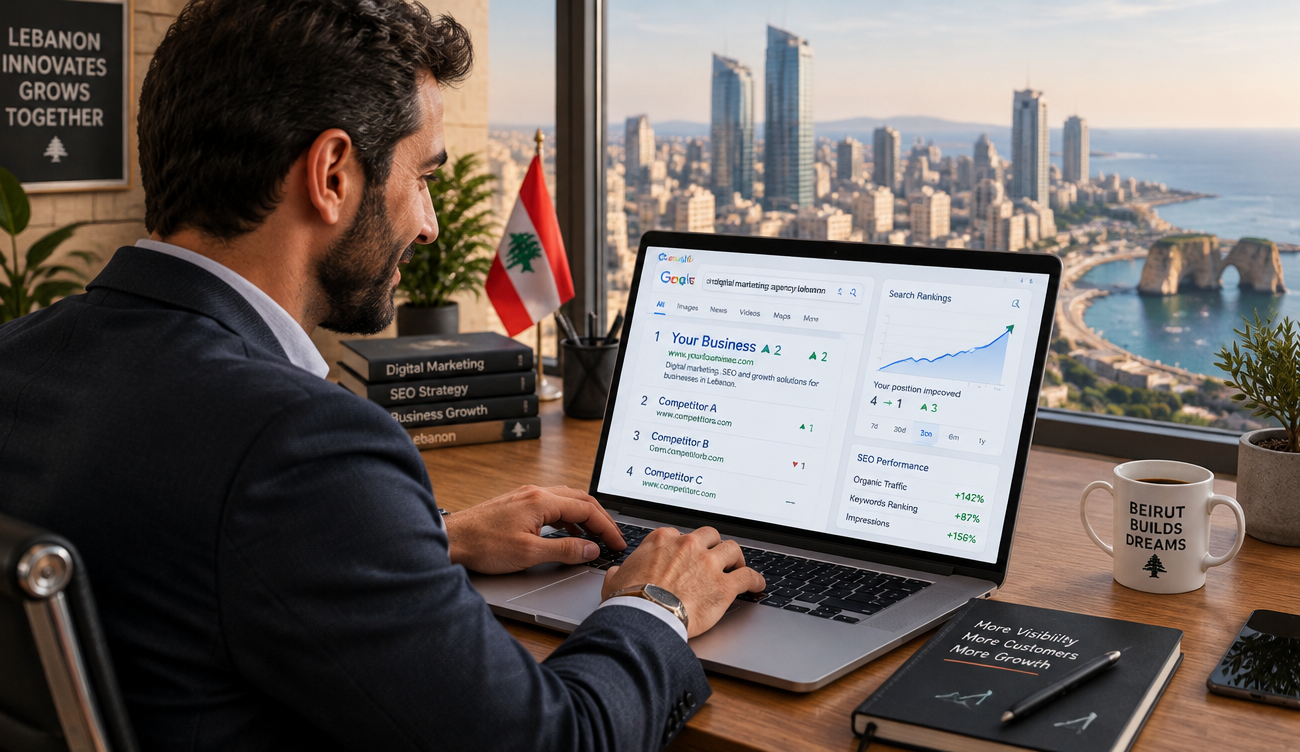
Most Lebanese businesses have touched SEO at some point — a batch of meta tags updated, a few blog posts published, maybe an agency hired for three months before the contract lapsed. What they haven’t had is an SEO solution: a coherent, compounding system where every part — technical foundation, content, local signals, structured data — reinforces every other part. That gap is expensive. In 2026, Lebanon’s digital search landscape has matured enough that ad-hoc optimization no longer holds position. The businesses showing up consistently at the top of Google for queries like “seo in lebanon,” “digital marketing beirut,” or “[your vertical] lebanon” aren’t the ones who tried harder. They’re the ones who built better. Here are seven reasons why the difference matters now more than ever — and why the right SEO solution compounds returns instead of just producing one-off wins. What’s changed in Lebanese search (the 2026 context) Three shifts have raised the bar for Lebanese businesses in search over the last 18 months: Google’s AI Overviews now answer transactional queries directly in the SERP, compressing clicks for generic content while rewarding sites with clear expertise signals — E-E-A-T (Experience, Expertise, Authoritativeness, Trustworthiness) is no longer optional, per Google’s own guidance on people-first content. AI search tools (ChatGPT, Perplexity, Google Gemini) are where younger Lebanese users increasingly start research for high-consideration purchases. These tools pull from structured, citation-worthy content — businesses without it are simply invisible. Core Web Vitals + mobile performance enforcement has tightened. Lebanese internet speeds vary sharply by region and carrier; a site that loads cleanly in Beirut on fibre often fails the CWV threshold for users on mobile outside the capital. Together, these shifts mean that an SEO solution that worked in 2022 — content for keywords, basic on-page optimization — no longer does enough. 7 Reasons Lebanese Businesses Need a Proper SEO Solution 1. Your competitors are compounding while you’re patching SEO isn’t a one-time fix. Each piece of content, each link earned, each technical improvement adds to a compounding authority score that Google tracks over months and years. A competitor who started building that authority 12 months ago isn’t just “ahead” — they’re pulling further ahead every week. The only way to close the gap is to start compounding yourself, not to run one-off campaigns. 2. Generic tactics don’t survive Lebanon’s search environment Lebanon has a market-specific search context that generic SEO solutions miss. Local-intent queries dominate commercial search (“seo services in lebanon,” “web design beirut”), and Google’s local ranking factors — Google Business Profile completeness, proximity signals, Lebanese-specific NAP consistency — operate differently from what a generic international playbook assumes. A solution built for Lebanon accounts for the bilingual SERP landscape (Arabic/English), regional carrier speed variances, and the trust dynamics of a relationship-driven market. 3. Technical debt silently kills organic traffic Unindexed pages, crawl traps, Core Web Vitals failures, and hreflang errors are invisible to most business owners — but not to Google. Many Lebanese sites run on stacks (WordPress + multilingual plugins like Polylang or WPML) that accumulate technical debt quickly without active management. A real SEO solution includes continuous technical auditing, not a one-time scan. We’ve seen sites lose 30–40% of organic traffic to technical issues that had no visible symptoms in the front-end experience. 4. Content without structure is wasted investment Publishing blog posts, service pages, and location pages without a coordinated content architecture creates keyword cannibalization — multiple pages competing for the same query, splitting authority and diluting rankings. A proper SEO solution starts with a keyword cluster map: which content lives where, how pages link to each other, and which queries each page “owns.” Without that architecture, more content often produces worse results, not better. 5. AI Overviews and AI search demand citation-ready content Appearing in Google’s AI Overviews or being referenced by ChatGPT/Perplexity requires content that is structured (FAQ blocks, clear headers, schema markup), authoritative (real expertise, real sourcing), and specific to the query intent. Lebanese businesses that are currently invisible in AI-generated answers are invisible to an increasingly large share of research-stage buyers. The content format that earns these citations is not generic blog writing — it requires deliberate GEO (Generative Engine Optimization) architecture. We cover this in depth in our AI SEO services page. 6. Local SEO and organic SEO must be coordinated One of the most common mistakes Lebanese SMBs make is treating Google Business Profile optimization as separate from their organic SEO strategy. In reality, the two signals reinforce each other: a well-maintained GBP improves local pack rankings, and strong organic authority improves the trust signals Google uses for local pack placement. A fragmented approach — one vendor handling content, another handling GBP — typically underperforms a coordinated one. Our local SEO Lebanon guide covers the coordination layer in detail. 7. Measurement without the right metrics produces false confidence CTR (click-through rate), not just ranking position, is what determines whether a ranking actually delivers traffic. A business ranking #5 for a high-volume query but showing a 0.5% CTR has a meta title and description problem, not a ranking problem. Similarly, tracking “sessions” without segmenting organic vs. paid vs. referral traffic hides where growth is actually coming from. A proper SEO solution includes a measurement framework tuned to the specific KPIs that signal real progress — ranking movement, CTR by query cluster, indexed page count, Core Web Vitals by device, and conversion events downstream. The compounding effect The businesses that win at SEO in Lebanon aren’t spending more — they’re spending smarter, consistently. Each technical fix compounds with the content above it. Each piece of content earns links that lift neighboring pages. Each well-maintained GBP listing reinforces the organic authority of the domain it points to. Six months into a structured SEO solution, a Lebanese business typically has: More pages ranking in positions 4–20 pulling into the top 3 A content library that’s earning backlinks passively A technical foundation that doesn’t need emergency repairs after every WordPress update A schema layer
AI SEO Lebanon: How AI-Powered SEO Wins in 2026
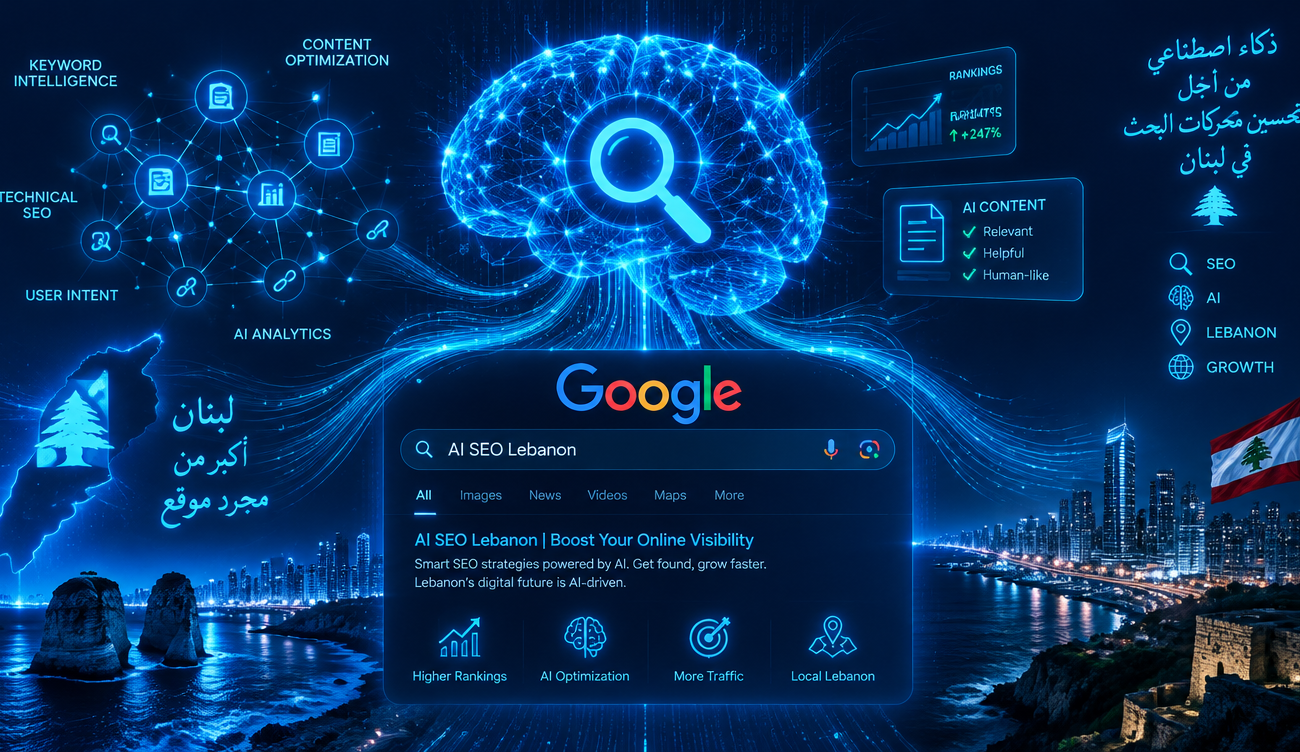
The businesses ranking at the top of Google in Lebanon right now have something in common: they are not doing SEO the way it was done three years ago. They are using AI — not as a buzzword, not as a shortcut to churn out thin content, but as a competitive edge in research, architecture, and optimization decisions that used to take weeks and now take hours. If you have searched “AI SEO Lebanon” and landed here, you are either curious whether AI-driven SEO actually works, or you are wondering whether your current agency is behind the curve. Both are fair questions. This post answers them directly. What Has Changed in Lebanese Search (and Why AI Changes the Game) Until recently, SEO in Lebanon was largely a volume game: publish more content, build more backlinks, repeat. Google’s algorithm has matured considerably, and so has the competitive landscape. Three shifts define 2026 Lebanese search: 1. Google rewards depth over volume. A single, well-structured page that answers a query comprehensively now outranks five thin pages that each skim the surface. AI tools let agencies identify exactly what depth a query demands — what questions are being asked around it, what entities Google associates with it, and what the top-ranking pages do that lower-ranking ones miss. 2. AI Overviews are rewriting click distribution. A growing share of Lebanese Google results now shows an AI-generated summary at the top of the page before the organic listings. Sites cited inside those summaries see disproportionate trust and traffic. Optimizing to appear in them (a discipline called GEO — Generative Engine Optimization) is now part of any serious SEO engagement. Google documents how these AI experiences pull from the open web in its official guidance on AI features and your website, and we cover the Lebanon-specific tactics in detail in GEO Lebanon 2026. 3. Technical gaps compound faster. With more content competing for Lebanese queries, technical issues — slow Core Web Vitals, crawl waste, duplicate content across Arabic and English versions — now cost rankings faster than they used to. AI-assisted auditing catches these issues systematically rather than depending on an analyst to spot them manually. 5 Ways AI-Powered SEO Creates a Real Edge in Lebanon 1. Keyword Clusters Built From Actual Intent, Not Just Search Volume Traditional keyword research finds terms with traffic. AI-powered research maps the intent graph around a topic — what questions users ask before, during, and after the primary search. For a Lebanese business targeting “digital marketing agency Beirut,” that means understanding which informational queries (why do I need SEO?) lead to commercial ones (best SEO agency Lebanon) and building a content architecture that captures the full funnel. The result: content that ranks for the primary keyword and twenty adjacent ones, instead of a page optimized for a single term that plateaus quickly. 2. Content Briefs That Close the Gap on Competitors Before writing a single word, AI analysis identifies precisely what the pages currently ranking for a target keyword do well and where they fall short — missing subtopics, weak FAQ coverage, thin entity signals. A brief built from that analysis produces content that is structurally designed to outperform, not just add to the pile. This is especially powerful in Lebanon’s English-language market, where most competing pages were built without this level of pre-production rigor. 3. Entity Optimization for Google’s Knowledge Graph Google does not just read keywords — it understands entities: businesses, people, places, concepts, and the relationships between them. Lebanese businesses that appear in Google’s Knowledge Graph (typically signaled by an accurate Google Business Profile, consistent NAP data, structured schema markup, and citation coverage across authoritative Lebanese directories) benefit from trust signals that keyword-only pages do not have. AI auditing maps which entities Google currently associates with a business and which gaps exist — NAP inconsistencies, missing schema types, unverified business categories — and prioritizes the fixes that move the needle fastest. We cover the local-specific side of this in local SEO Lebanon 2026. 4. Programmatic Technical Audits at Scale A Lebanese e-commerce site with 2,000 product pages, an Arabic-English WPML setup, and five years of accumulated redirects cannot be audited meaningfully by hand in a week. AI-assisted crawling and analysis surfaces the highest-impact technical issues first: crawl traps, indexation waste, page-speed regressions, hreflang mismatches, and duplicate-content chains. Fixes get prioritized by expected ranking impact, not by whatever a junior analyst noticed first. This is the foundation we describe in why SEO architecture beats basic ranking tactics — AI makes that architecture work faster and more systematically. 5. Continuous Monitoring Instead of Quarterly Audits Traditional SEO involves an audit, a six-week implementation, a wait, and then a retrospective. AI-driven monitoring watches rankings, crawl health, and competitor positioning continuously. When a ranking drops after a Google update or a competitor publishes a new page, the signal is immediate — not discovered three months later at the next review. For Lebanese businesses in fast-moving categories (real estate, e-commerce, professional services), this speed advantage compounds quickly. The Compounding Effect AI-powered SEO is not faster because it cuts corners — it is faster because it eliminates the cycles wasted on the wrong priorities. A business that correctly identifies its top-3 technical issues and its highest-intent content gaps in week one starts moving rankings in month one, instead of spending the first two months on discovery. That head start compounds. Rankings that move earlier build domain authority earlier. Domain authority built earlier makes the next content piece rank faster. By month six, a business that started with AI-informed SEO in January has a structural advantage over a competitor that ran a traditional campaign alongside it — not because any one tactic was magic, but because the sequencing was correct from the start. This compounding is why the businesses that rank at the top of Lebanese search right now are often those that invested in correct architecture early, as we documented in SEO services in Lebanon. How Ucheed Approaches AI SEO in Lebanon We
SEO for Clinics and Hospitals in Lebanon: Attract More Patients
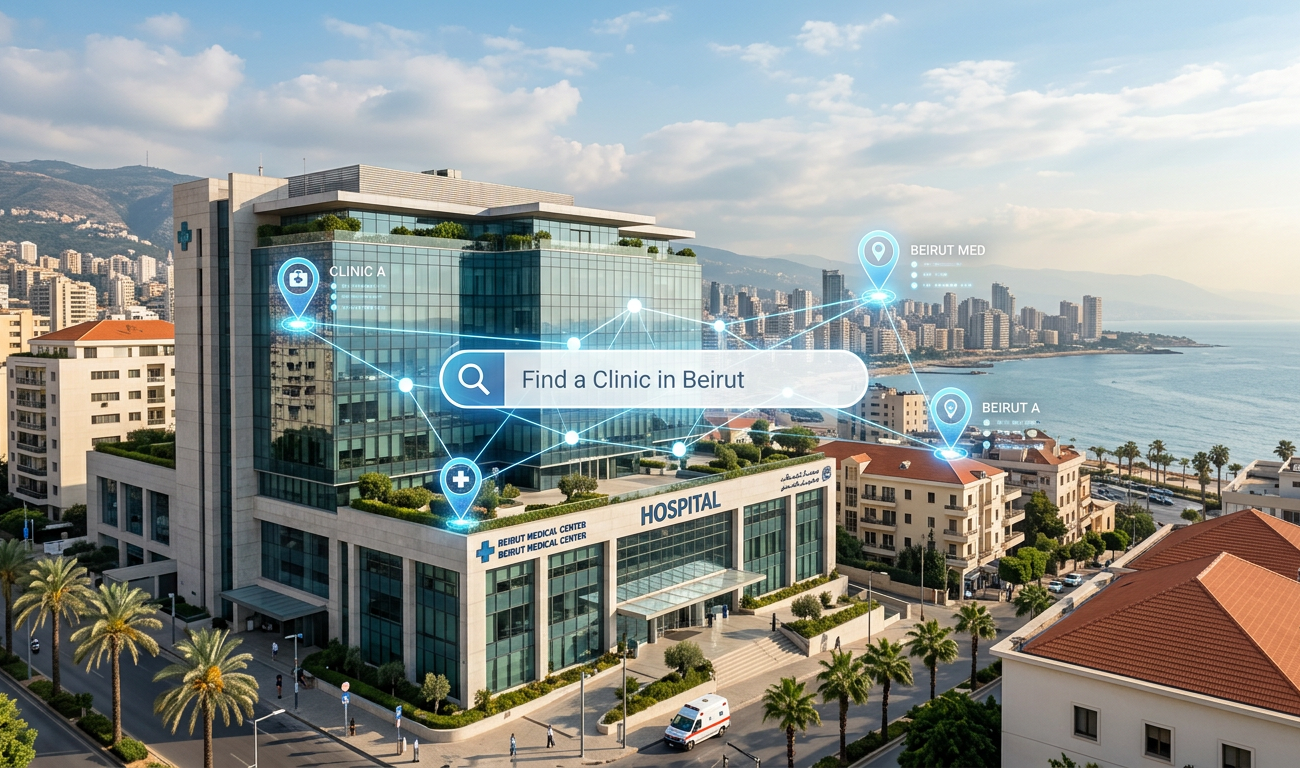
SEO for Clinics and Hospitals in Lebanon: How Healthcare Institutions Win Patient Search SEO for clinics in Lebanon starts the moment a patient reaches for search. When someone in Beirut needs a pediatrician, a diagnostic center, or emergency care, they don’t call around anymore — they search: “best hospital in Beirut,” “pediatric clinic Achrafieh,” “24-hour clinic near me.” For a clinic or hospital, that search behavior is different from a single practitioner’s — it’s higher volume, more urgent, and spread across departments, locations, and dozens of individual doctors. Winning it requires an SEO approach built for an institution, not a solo practice. That’s a structural problem, and it’s a solvable one. Why institutional healthcare SEO is a different problem than a single doctor’s We covered the individual-practitioner side of this in SEO for doctors in Lebanon — trust signals, reviews, and Google Business Profile optimization for one provider. Clinics and hospitals face the same YMYL (Your Money Your Life) scrutiny from Google, but multiplied: multiple departments, multiple practitioners, often multiple branches across Beirut, Jounieh, or Tripoli, and search intent that ranges from scheduled (“book a dermatology consultation”) to urgent (“emergency room near me now”). A site architecture built for one doctor’s bio page breaks down fast at institutional scale. What actually moves the needle for a Lebanese clinic or hospital A dedicated page per department or specialty, not one blended “Services” page. Cardiology, pediatrics, radiology, emergency care — each needs its own page targeting its own search intent, the same principle we outline for legal practice areas in why SEO architecture beats basic rankings. A single catch-all page dilutes relevance for every specialty at once. Individual doctor profile pages, linked into a clear hub-and-spoke structure. Patients search by both specialty and practitioner name. Doctor bio pages should sit beneath department pages and link back to them, reinforcing topical relevance instead of competing with it — the linking pattern we detail in SEO for doctors in Lebanon. A Google Business Profile — and local pack strategy — per physical location. A hospital with branches in three cities needs three optimized, distinctly verified profiles, not one. The local ranking factors we outline in local SEO strategies to dominate Beirut search results apply per-branch here, and get more complex as branch count grows. Structured data at institutional scale. Hospital or MedicalClinic schema at the organization level, Physician schema on individual doctor pages, and department-level MedicalSpecialty markup helps Google (and AI search engines) understand the institution’s structure rather than guessing at it. E-E-A-T signals multiplied across every practitioner. Accreditations, hospital-wide certifications, and a review-management process that works across dozens of doctors — not just one — are what separate institutions that rank from institutions that merely exist online. The same rigorous E-E-A-T standards Google documents in its helpful, reliable, people-first content guidance apply at every layer of a healthcare institution’s site. Multilingual coverage (Arabic/English/French). Lebanese patients search in all three; department and doctor pages that only exist in one language leave visibility on the table. The compounding effect at institutional scale A single doctor’s authority is built page by page. A clinic or hospital’s authority compounds across every department and practitioner page that’s structured correctly — each well-optimized doctor profile reinforces the department above it, and each department reinforces the institution’s overall trust signal. Get the architecture right once, and every new hire’s bio page adds to the same compounding asset instead of starting from zero. How Ucheed approaches SEO for clinics in Lebanon We treat hospital and clinic SEO as an information-architecture problem first: mapping departments, practitioners, and locations into a structure Google can parse, then layering in the local, multilingual, and E-E-A-T signals that convert search visibility into appointment volume. It’s the same methodology behind our SEO services in Lebanon, scaled for multi-department, multi-location healthcare institutions. Ready for your institution to be the clinic or hospital patients find first? Talk to Ucheed about a healthcare-sector SEO audit. FAQ How is SEO for a hospital different from SEO for one doctor? A hospital needs department-level architecture, per-location Google Business Profiles, and organization-wide schema and review management across many practitioners — a single doctor’s SEO only has to solve one profile’s worth of trust signals. Should each hospital branch have its own page, or one shared page for all locations? Each physical branch should have its own dedicated, locally-optimized page and Google Business Profile — a single shared location page dilutes local pack visibility for every branch.
Monthly SEO Services in Lebanon 2026: Why the Retainer Model Delivers Compound Results
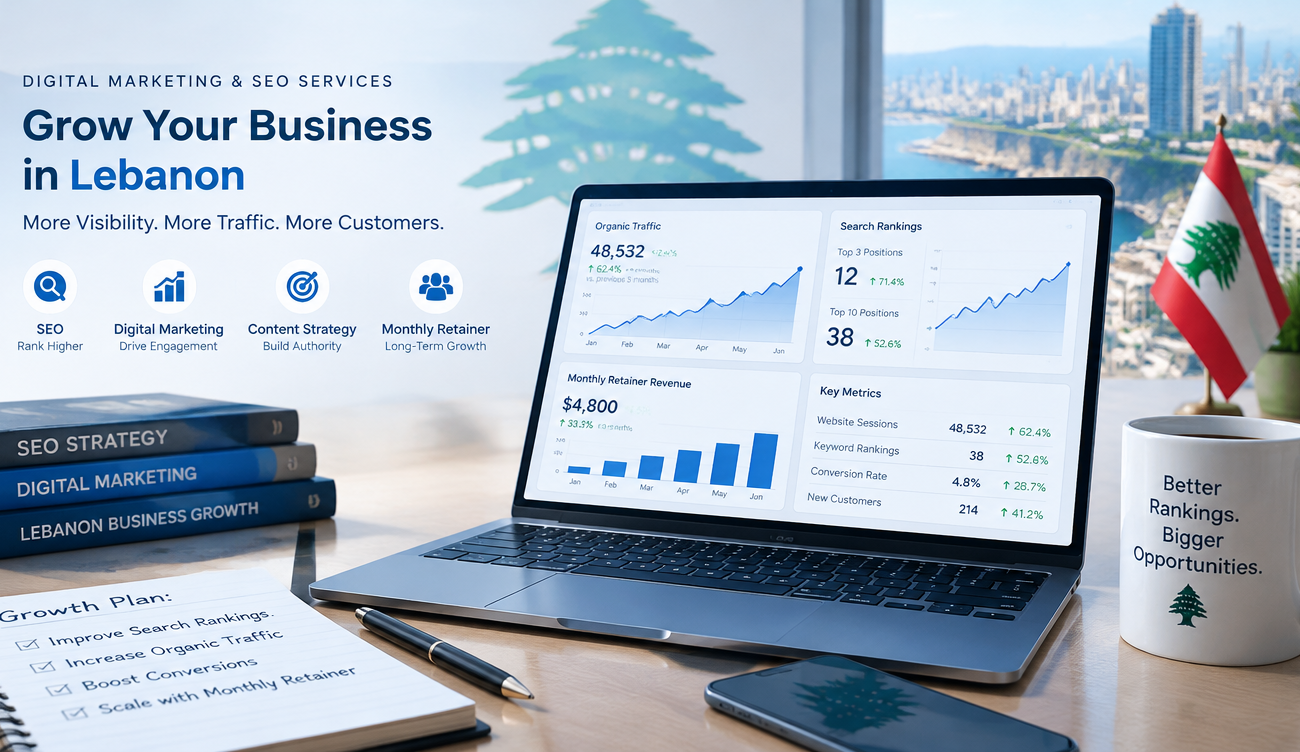
Monthly SEO Services in Lebanon 2026: Why the Retainer Model Delivers Compound Results Most Lebanese businesses approach SEO like a renovation project: hire an agency, get the site fixed, then move on. Six months later, rankings have slipped, competitors have overtaken them, and the whole cycle starts again — at a higher cost. Monthly SEO services exist precisely to break this pattern. In 2026, with Google’s algorithm updating more than 1,000 times a year and AI Overviews appearing in 42% of informational search results, the question is no longer whether to invest in SEO — it’s whether a one-time effort can possibly keep pace. What Changed in 2025–2026 That Makes Monthly SEO Non-Negotiable Three shifts have fundamentally raised the bar for Lebanese businesses competing in organic search: Google’s March 2025 Broad Core Update added new weight to content freshness and expertise signals. Pages that hadn’t been updated since 2023 lost ground to actively-maintained competitors almost overnight — not because the content was wrong, but because it was stale. AI Overviews arrived in Lebanese-relevant SERPs in mid-2025. Google now synthesises answers from multiple sources before showing traditional results. Without ongoing GEO (Generative Engine Optimisation) work alongside traditional SEO, even page-one rankings may deliver fewer clicks than they used to. Core Web Vitals thresholds tightened in April 2025, with the LCP “Good” threshold moving to ≤2.0 seconds. Per Google Search Central’s Core Web Vitals documentation, these page-experience signals feed directly into how Search evaluates real-world performance. Google’s CrUX data refreshes monthly — a page that passed your 2024 audit may be underperforming today without anyone noticing. None of these shifts are one-time events. They represent a permanently faster pace of change in organic search. Monthly SEO services are how serious businesses keep up. 1. Why SEO Is Never “Done” There is a persistent myth in the Lebanese market that SEO is a project with a finish line: build the site right, optimise the pages, submit to Google, done. This is how one-time SEO projects are sold — and how businesses end up re-purchasing the same foundational work every 18 months at increasing cost. The reality is that organic search is a dynamic competitive environment. While your site stays static, competitors are publishing new content, earning backlinks, refreshing old posts, and improving their Core Web Vitals scores. Google’s algorithm — updated an average of three times per day in 2025 — continuously re-evaluates which results best answer a given query. A position held today is not guaranteed tomorrow. Ongoing monthly SEO services address this by treating search visibility as an operational function, not a project. The agency monitors rankings weekly, identifies new opportunities as they emerge in GSC data, adapts to algorithm shifts, and builds on work from previous months rather than starting from scratch. 2. What Monthly SEO Services Actually Include Not all monthly SEO retainers are created equal. Here is what a professional monthly SEO engagement for a Lebanese business should include at minimum — and what is often quietly omitted from cheaper packages: Core deliverables (every month): Keyword opportunity review: pulling fresh GSC data to identify queries moving into near-rank position (typically 4–20), new impression spikes, and CTR anomalies worth addressing Content creation or refresh: at minimum 2–4 optimised posts or page updates per month; higher-tier retainers include 8–12 pieces plus translation for Arabic audiences Technical monitoring: crawl error review, index coverage check, Core Web Vitals tracking, and immediate response to any penalty signals On-page optimisation: iterating title tags, meta descriptions, and internal linking structure as ranking data reveals opportunities Link building activity: outreach, digital PR, or directory work to build topical authority month by month GSC + GA4 reporting: a plain-language monthly report showing what moved, why, and what comes next What should be included but often isn’t in cheap packages: GEO/AEO optimisation for AI Overview inclusion Arabic-language SEO (EN + AR bilingual management) Schema markup maintenance and structured data updates Proactive competitor monitoring 3. Monthly vs One-Time SEO: The Real Comparison The “monthly vs one time SEO” debate is ultimately about compounding versus restarting. Here is how the two approaches actually play out for a Lebanese business over 12 months: Factor One-time SEO project Monthly SEO retainer Month 1–3 results Strong initial movement as fixes take effect Moderate movement while strategy is established Month 4–6 results Plateau or decline as competitors adapt Accelerating growth as content authority builds Month 7–12 results Significant decline; often back to starting point Compounding returns; new keyword clusters opening Algorithm update impact High risk — no one monitoring or responding Low risk — issues identified and resolved within weeks Total 12-month cost Lower upfront; often requires repeat purchase Higher upfront; no repeat foundation work needed ROI trajectory Front-loaded then declining Slow start, then exponential as authority compounds For most Lebanese businesses with consistent revenue goals, the monthly model costs less over a 24-month horizon than two or three separate one-time projects — and it delivers a durable asset rather than a series of resets. 4. How to Choose the Right Monthly SEO Package for Your Stage The right monthly SEO investment depends on where your business sits relative to the competition, not on a fixed budget figure. Three factors should drive your package decision: Your current domain authority. New sites (DA below 20) need more foundational content and link-building work before ranking improvements are visible. Expect a 6–9 month ramp before significant organic traffic. Established sites (DA 30+) can often see meaningful movement within 60–90 days of starting a monthly programme. Your keyword competition level. Local Lebanese searches (“accountant in Beirut”) are far less competitive than broad regional terms (“SEO company”). A $600/month retainer can dominate local SEO service queries in Beirut and across Lebanon; the same budget may not move the needle on GCC-scale competition without 12+ months of content investment. Your ability to execute on content. Monthly SEO services require a cadence of published content. Agencies can produce this content for you (more expensive) or work from your subject-matter input
SEO for Hotels & Hospitality in Lebanon

Search for “hotels in Beirut,” “boutique hotel Batroun,” or “best resort in Faraya” and the first page is rarely dominated by the hotels themselves — it’s Booking.com, Expedia, and Airbnb. Every guest who books through one of those listings instead of the hotel’s own site hands over a 15-25% commission before the room is even cleaned. That’s not a pricing problem. It’s an SEO problem, and for most Lebanese hotels and guesthouses, it’s an entirely solvable one.How Lebanese hotels, resorts, and guesthouses can win direct organic bookings and reduce dependency on Booking.com/Expedia commissions — the hospitality SEO playbook from Ucheed.
Become the #1 Restaurant on Google with Local SEO Lebanon
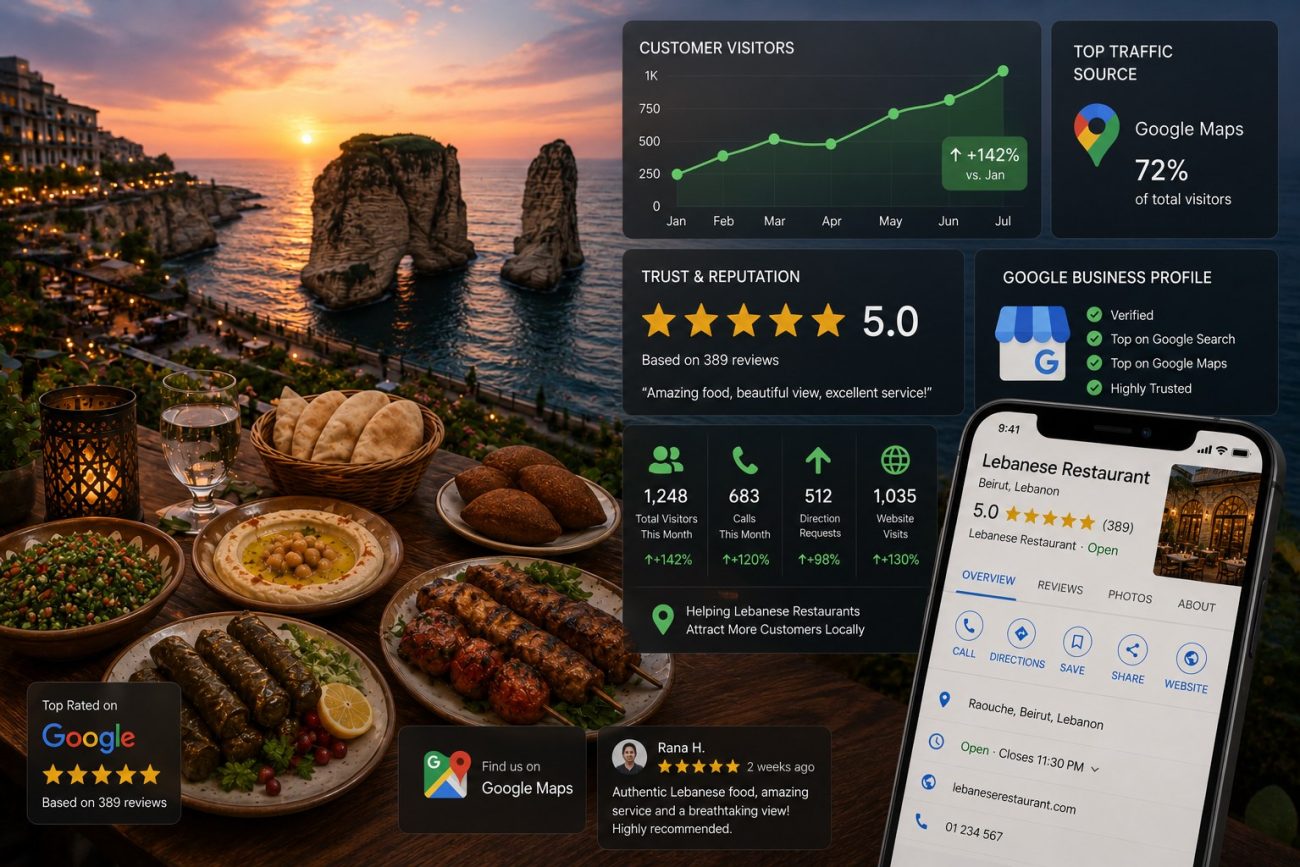
Local SEO Lebanon Guide: How to Become #1 on Google Search When Customers Look for Restaurants In today’s restaurant industry, serving great food is no longer enough. When people feel hungry, they often reach for their phones before they decide where to eat. They search for phrases like “best burger near me,” “family restaurant in Beirut,” or “seafood restaurant nearby.” Within seconds, Google shows them a list of restaurants, maps, reviews, photos, and directions. This is exactly why Local SEO Lebanon has become a critical growth strategy for restaurants that want to attract more customers and increase reservations. The restaurants that appear first often get the customer. This is why understanding a local seo lebanon guide is becoming essential for restaurant owners, restaurant groups, and F&B chains across Lebanon. Whether you operate a single restaurant in Beirut or manage multiple locations across the country, local search visibility directly impacts reservations, walk-ins, delivery orders, and overall brand awareness. This comprehensive local seo lebanon guide explains how restaurants can improve their digital presence, strengthen their visibility on Google Maps, build customer trust, and attract more diners through effective local search strategies. Why Restaurant Websites Still Matter in 2026 Many restaurant owners believe social media alone is enough. While Instagram, TikTok, and Facebook are important, your website remains one of the strongest digital assets you own. A website acts as the foundation of every successful local seo lebanon strategy. Google uses website content, structure, speed, and authority to determine how trustworthy your restaurant is. A well-optimized website helps: Increase online reservations Display menus clearly Showcase locations Highlight customer reviews Improve Google rankings Strengthen brand credibility Many restaurant groups investing in local seo discover that website optimization directly contributes to increased bookings and customer engagement. Businesses that work with experienced seo services providers often focus first on creating a website that accurately reflects every restaurant location while delivering a seamless customer experience. Understanding How Customers Search for Restaurants Before discussing technical optimization, it is important to understand customer behavior. Most restaurant searches fall into three categories: 1. Discovery Searches Examples include: Best Lebanese restaurant near me Italian restaurant in Beirut Family dining in Lebanon These searches introduce customers to new restaurants. 2. Decision Searches Examples include: Restaurant reviews Beirut Best seafood restaurant reviews Top-rated restaurants near me At this stage, reviews and ratings become extremely important. 3. Action Searches Examples include: Call restaurant now Book table online Get directions This is where strong implementation of a local seo lebanon guide turns search visibility into actual customers. How Website Rankings Influence Restaurant Revenue The first page of Google receives the majority of clicks. When a restaurant appears consistently in local search results, customers perceive it as more trustworthy. Strong seo lebanon strategies help restaurants achieve visibility for searches related to: Cuisine types Restaurant locations Delivery services Event hosting Family dining Corporate catering For example, if a restaurant in Beirut consistently appears for relevant searches, it can significantly outperform competitors that rely solely on social media. This is one reason many businesses invest in professional seo marketing initiatives that focus on long-term visibility rather than short-term advertising campaigns. The Role of Location Pages in Restaurant SEO One of the most overlooked elements in this local seo lebanon guide is location-specific website content. Restaurant chains often create a single website page and expect it to rank for multiple areas. Instead, each location should have its own dedicated page. Each page should include: Restaurant address Contact information Opening hours Parking information Menu highlights Location-specific photos Customer reviews Embedded Google Map These pages strengthen both local seo lebanon performance and user experience. For restaurant groups operating across Beirut and other regions, dedicated location pages can dramatically improve visibility in local search results. Reviews: The Hidden SEO Asset Most Restaurants Ignore Customer reviews are much more than social proof. Google analyzes review signals to understand business popularity, relevance, and trustworthiness. Positive reviews help strengthen: Local rankings Click-through rates Brand perception Customer confidence Reviews also contain natural keywords that reinforce restaurant relevance. For example, when customers repeatedly mention: “best breakfast in Beirut” “great family restaurant” “excellent Lebanese food” Google begins associating the restaurant with those search terms. This is why every effective local seo lebanon guide emphasizes review management. Why Regular Customer Reviews Help Restaurants Rank Higher on Google Review velocity refers to the frequency at which businesses receive new reviews. A restaurant receiving reviews consistently every week often appears more active than a restaurant receiving reviews only a few times per year. Google tends to favor businesses showing continuous engagement. To encourage reviews: Ask satisfied customers politely Add QR codes on tables Follow up after reservations Include review requests in email communications Restaurants working with experienced seo company lebanon specialists often implement structured review acquisition strategies that generate steady customer feedback. Optimizing Your Google Business Profile Your Google Business Profile is arguably the most important local ranking factor. A properly optimized profile helps restaurants appear in: Google Maps Local Pack Results Mobile Searches Voice Searches Every restaurant should ensure: Accurate Business Information Maintain consistency across: Business name Address Phone number Website URL Updated Opening Hours Incorrect hours create customer frustration and negative reviews. High-Quality Photos Google favors businesses with active photo updates. Include: Dining areas Signature dishes Exterior signage Staff interactions Service Details Specify: Dine-in Delivery Takeaway Reservations This step is fundamental to any successful local seo lebanon guide strategy. How Google Maps Influences Customer Decisions Many customers never visit a restaurant website. Instead, they discover restaurants directly through Google Maps. Maps now function as a decision-making platform. Customers evaluate: Ratings Photos Distance Popular times Reviews Directions Strong visibility on Maps can directly increase: Walk-in traffic Reservation requests Delivery orders Businesses investing in lebanon seo services often prioritize Google Maps optimization because it produces measurable local results. Why Google Trusts Some Restaurants More Than Others Google wants to recommend businesses that provide positive experiences. Trust signals help Google determine whether a restaurant deserves visibility. Important trust signals include: Consistent
SEO for Doctors in Lebanon: Become #1 on Google Search
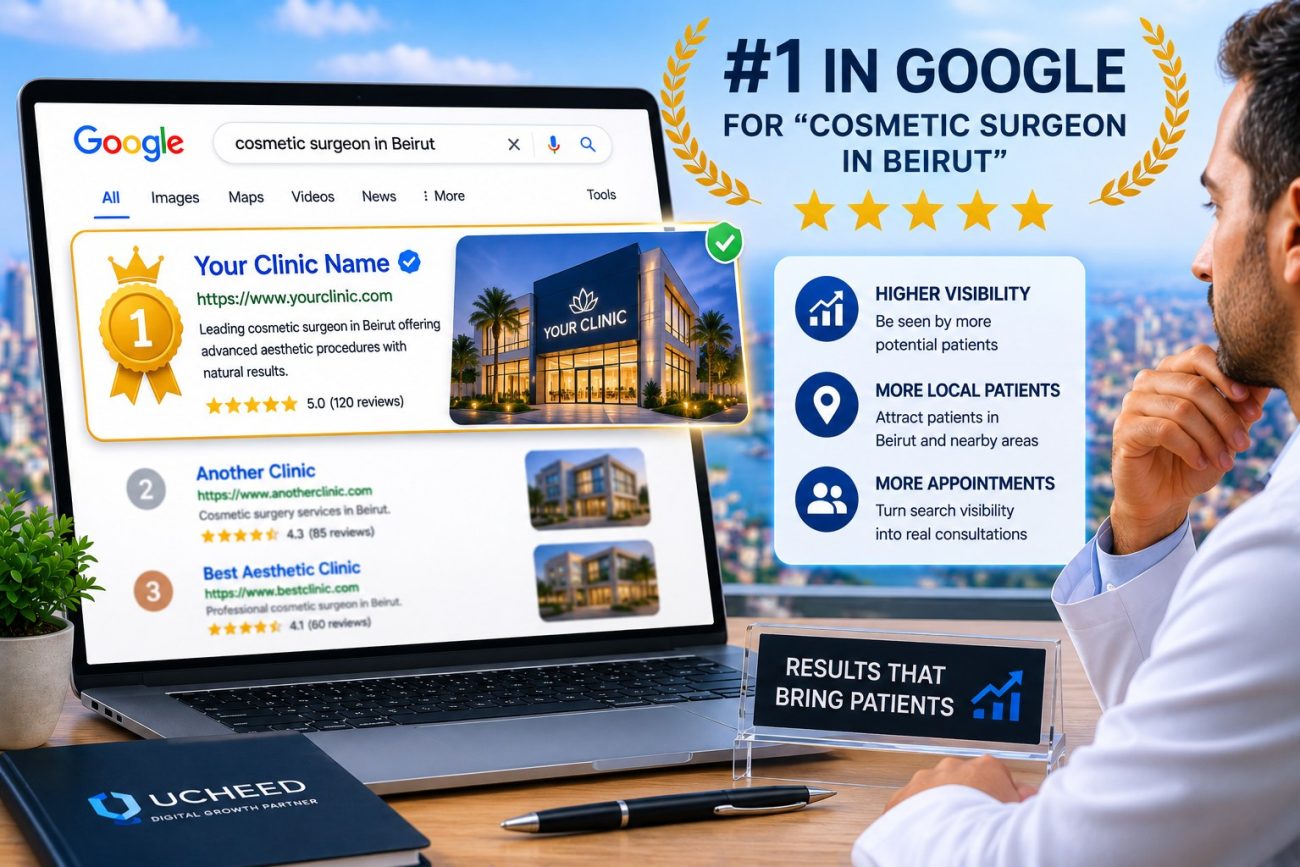
SEO for doctors in Lebanon: Building Clinical Credibility on Google Why patients choose Google before they choose a clinic A doctor can have excellent training, years of experience, and strong word-of-mouth referrals, yet still lose visibility online if patients cannot quickly confirm who they are, what they treat, where they practice, and how to book. In Lebanon, that problem matters because digital discovery is no longer optional: internet penetration in the country stood at 91.6 percent at the start of 2025, and Google Business Profile is designed to help eligible businesses appear on Google Search and Maps, where people can immediately check location, hours, website, and contact details. That is the real starting point for seo for doctors in lebanon. It is not about tricking an algorithm or stuffing a site with repetitive phrases. It is about reducing uncertainty. Google’s own local guidance emphasizes that complete business information helps people understand what a business does, where it is, and when they can visit, while verified profiles are more likely to show in search results. For a clinic, that means visibility and reassurance are closely linked. For that reason, the best seo for doctors in lebanon sits at the intersection of trust, structure, and convenience. It combines a credible website, accurate local listings, clear service descriptions, and content that answers real patient questions in a responsible way. In practical terms, that is where seo in lebanon, seo Lebanon, and Lebanon SEO stop being abstract marketing terms and become part of patient access. Google’s people-first content guidance is explicit that useful content should be created for readers, not merely to attract search traffic. At Ucheed, the most useful way to frame this topic is simple: a clinic becomes easier to choose when it becomes easier to verify. Search visibility helps patients verify expertise, location, services, and availability at the exact moment they need care. That framing is consistent with how Google describes Business Profiles and with how Google asks site owners to think about helpful, reliable content. Why medical visibility is really a trust problem Google’s Search Quality Rater Guidelines place health and safety content inside YMYL topics because inaccurate or untrustworthy information can significantly affect a person’s wellbeing. The same guidelines say that pages on clear YMYL topics are held to higher standards and explicitly show that medical pages require a high level of user trust. That is why seo for doctors in lebanon should begin with credibility signals before it begins with keyword expansion. A page about cardiology, fertility, dermatology, pediatrics, orthopedics, or surgery is not judged like a casual lifestyle article. Google’s people-first content documentation recommends clear sourcing, background about the author or the site, expert review where readers would expect it, and visible information about who created the content. Google also says that clear bylines and authorship information help readers intuitively understand E-E-A-T. In other words, strong medical SEO is often disciplined information design. A clinic should have a complete About page, physician profile pages, contact information, consultation instructions, and service pages that explain care areas in plain language. Good Search Engine Optimization in healthcare is not the same thing as exaggerated claims. It is much closer to patient education plus information architecture. That fits both Google’s people-first content guidance and its local business guidance, which asks businesses to represent themselves accurately and consistently in the real world. This matters especially in competitive city searches. In SEO in Beirut, for example, a clinic is not only competing with nearby practices; it is also competing with hospital websites, Maps listings, directories, and multilingual results. Lebanon’s official language is Arabic, while English and French are widely spoken, and Google recommends clean multilingual implementations when a site publishes in more than one language. That reality makes seo for doctors in lebanon as much a clarity problem as a ranking problem. A useful self-check is simple: if a patient lands on the page without already knowing the doctor, can they immediately understand the specialty, the location, the credentials, the booking path, and the next step? If the answer is no, then the clinic has a visibility problem and a trust problem at the same time. That is exactly the kind of gap Google’s quality and page-experience guidance pushes site owners to fix. How to show a doctor’s services clearly and systematically Many clinic websites lose visibility not because the doctor lacks expertise, but because the site hides expertise behind vague navigation and generic copy. Google states that title links are often the primary element people use to decide whether to click a result, and that snippets are meant to preview the part of a page most relevant to a user’s search. Google also recommends page-specific descriptions, clear main titles, and descriptive internal links so people and Google can understand what each page is about. For clinics, that means each major service should usually have its own page, or at minimum its own clearly defined section with its own heading and descriptive copy. A general “Services” page is rarely enough if it mixes consultations, procedures, diagnostics, insurance details, and hospital affiliations without hierarchy. A stronger SEO Website for a doctor separates these elements so a patient searching by specialty, treatment, symptom cluster, or doctor name can land on the exact page that matches the need. A robust SEO Website for healthcare also explains services in patient language rather than internal medical shorthand alone. If the page is about pediatric vaccination, the title should say that clearly. If it is about orthodontics, the heading should not be a vague slogan. If it is about fertility evaluation, the page should explain what the service covers, who it is for, and what action the patient can take next. Google’s title-link and snippet guidance is built around this exact principle of clarity. Structured data strengthens that clarity. Google says structured data gives it standardized information about the content of a page and about people, organizations, and places. Google’s Local Business structured data documentation explains that site owners can communicate information such as business hours and departments, while ProfilePage structured data helps define pages that are about a
Why SEO Services Are Paid Monthly in Lebanon ?
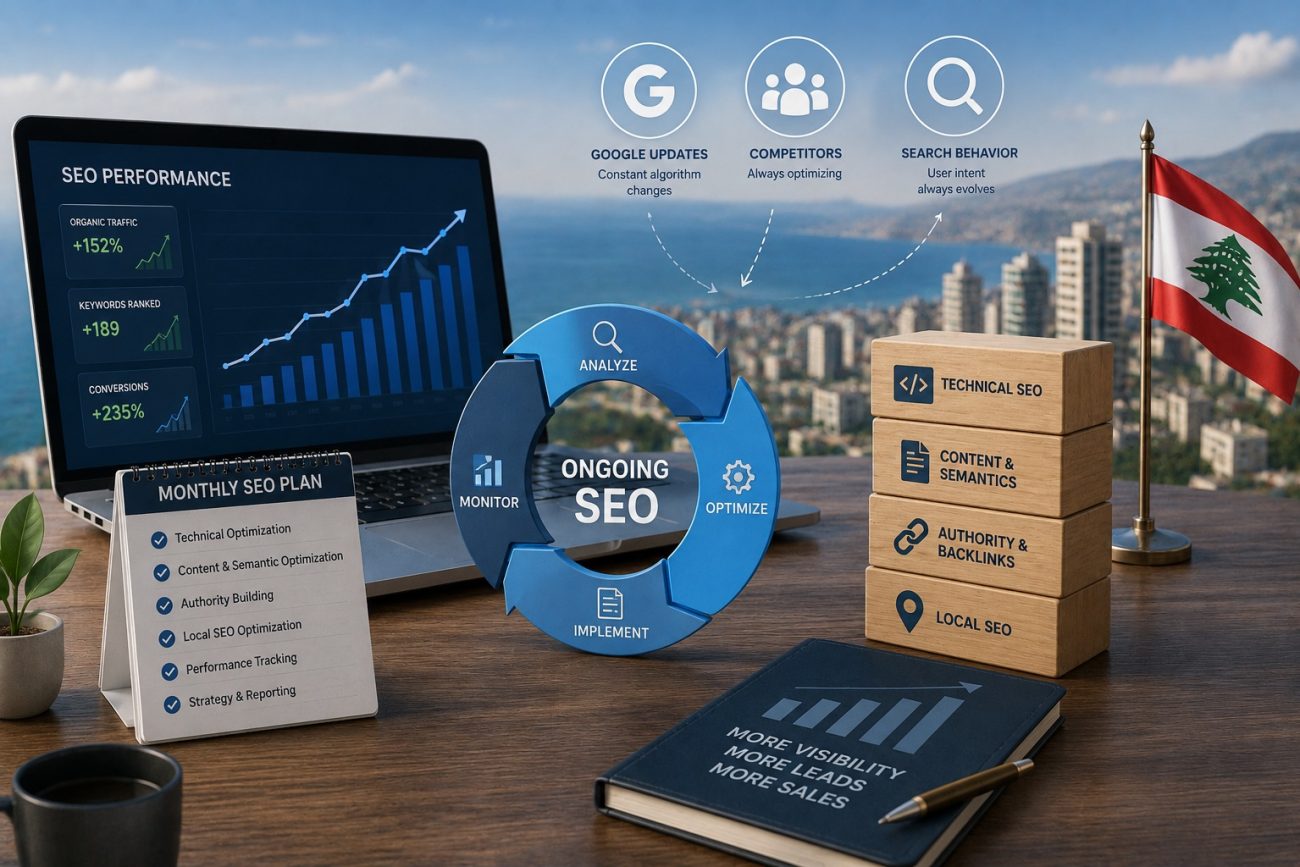
Why SEO Services Are Monthly Paid: The Real Reason Businesses in Lebanon Need Ongoing SEO SEO services require monthly payments because search engine optimization is a continuous market competition, not a static setup. Google constantly updates its ranking algorithms, while competitors actively optimize their sites and consumer search behavior shifts. Ongoing technical, semantic, and authority optimizations are required to maintain organic visibility, prevent decay, and secure compounding sales revenue. Introduction It is one of the most common questions asked by business owners and decision-makers when first confronting the reality of digital marketing: “Why do SEO agencies charge a monthly fee? We already paid to build and optimize the website last year why is this not a finished project?” The expectation that search engine optimization is a static, one-time setup is a widespread misconception that often leads to costly strategic mistakes. In a competitive digital landscape, treating your search visibility as a fixed installation rather than an active, ongoing system is a recipe for long-term invisibility. The digital economy in the Levant is characterized by extreme volatility and rapid transformation. With internet penetration in Lebanon now standing at over 91.8% and mobile download speeds climbing to 43.90 Mbps, the way consumers discover, evaluate, and choose brands has fundamentally changed. Today, search performance is not merely a cosmetic add-on; it is a critical engine for business growth, brand authority, and customer acquisition. When you invest in seo services, you are not purchasing a static product like a logo or a physical signpost. You are investing in a continuous, dynamic process designed to adapt to ever-shifting search algorithms, competitor strategies, and customer behaviors. To successfully navigate this environment and secure your market position, you must understand that search engines do not operate in a vacuum. Google’s database is updated billions of times a day, meaning that your rankings from last month are constantly being challenged by active, aggressive competitors who are investing in search visibility. To build sustainable digital authority, businesses must partner with a specialized seo company lebanon that understands how to translate search data into predictable, compounding revenue. By transitioning your mindset from a transactional “setup” to an ongoing “growth system,” you can turn search results into your most valuable business asset. As explored in our comprehensive guide to seo in lebanon, organic search is a compound marketing channel where the efforts of today serve as the foundation for the exponential growth of tomorrow. By partnering with Ucheed, businesses move away from the traditional, passive customer acquisition models. Our approach as digital growth architects is built on the reality that time is a business’s most precious asset. We don’t just optimize; we build scalable digital systems that ensure your brand is not only ranked but cited and trusted across traditional and AI-driven platforms alike. Through continuous optimization and strategic alignment, we turn raw digital potential into a lead-generating reality. SEO Is Not Like Building a Website To understand why ongoing search optimization is essential, it helps to analyze the structural difference between web development and search visibility. A website is a digital asset with a defined beginning, middle, and end. Once the custom code is written, the databases are integrated, the payment gateways are secured, and the user interface is launched, the technical phase of building the platform is complete. While it requires maintenance and security updates, the website itself stands as a finished structure. Search optimization, however, is not a static asset. It is an ongoing, competitive race against active opponents in a fluid environment. When a professional agency optimizes your site, they are positioning your brand on a shifting surface. This surface is constantly modified by three primary forces: Continuous Algorithm Evolutions: Search engines like Google introduce thousands of minor updates and several major core algorithm changes every year. These updates are designed to refine search quality, combat automated spam, and prioritize content that demonstrates real-world experience, expertise, authority, and trustworthiness (E-E-A-T). An algorithm update can instantly change how a search engine interprets your pages, requiring immediate technical adjustments. Competitor SEO Activity: You do not own your organic rankings; you only rent them. Every business in your sector is competing for the same limited spots on the first page of search results. If a competitor publishes deeper content, resolves their technical errors, or secures high-quality backlinks, they will displace your brand in search rankings. Evolving Search Patterns: The way Lebanese consumers search for information is highly dynamic. Search queries are transitioning from short keyword phrases to natural, conversational, and prompt-based queries. Furthermore, the local market’s unique trilingual nature means that a modern lebanon seo strategy must continuously monitor and adapt to shifting linguistic preferences across English, Arabic, and French. By treating search visibility as a one-time project, you are essentially setting a ship’s sails once and then walking away from the wheel. The currents of competition and the winds of algorithm changes will quickly push your business off course, leaving your rankings to decline while active brands capture your high-intent traffic. At Ucheed, we act as Digital Growth Architects. We help businesses understand that true digital transformation is not about reaching a static destination; it is about building an adaptable, high-performing growth engine through continuous optimization and expert seo services. What Happens Every Month in SEO Services? When a business partners with a professional digital growth company, the monthly retainer does not fund passive monitoring. It drives a highly structured, continuous workflow of technical, semantic, and off-page optimizations designed to keep your digital system running at peak performance. A high-quality retainer for monthly seo services covers several critical, ongoing tasks: Dynamic Keyword Research Updates: Search intent is not static. Our team continuously monitors search trends, identifying “Breakout Topics” and emerging search patterns before they are saturated by competitors. This proactive analysis allows us to target valuable long-tail queries and “Opportunity Voids” while they are still highly profitable. Technical SEO Maintenance & Auditing: Websites naturally accumulate technical debt over time. Every new product page, image upload, or plugin update