

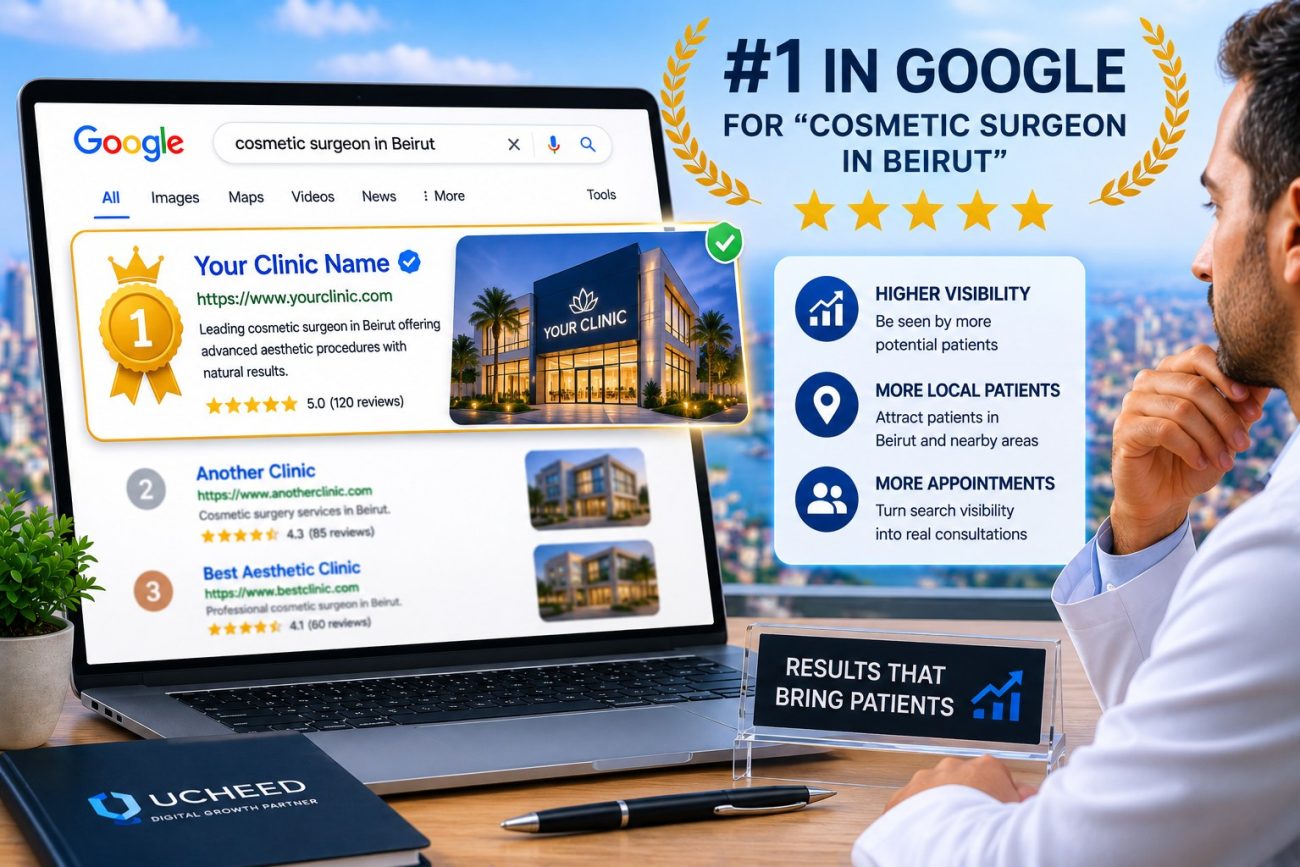
SEO for doctors in Lebanon: Building Clinical Credibility on Google
Why patients choose Google before they choose a clinic
A doctor can have excellent training, years of experience, and strong word-of-mouth referrals, yet still lose visibility online if patients cannot quickly confirm who they are, what they treat, where they practice, and how to book. In Lebanon, that problem matters because digital discovery is no longer optional: internet penetration in the country stood at 91.6 percent at the start of 2025, and Google Business Profile is designed to help eligible businesses appear on Google Search and Maps, where people can immediately check location, hours, website, and contact details.
That is the real starting point for seo for doctors in lebanon. It is not about tricking an algorithm or stuffing a site with repetitive phrases. It is about reducing uncertainty. Google’s own local guidance emphasizes that complete business information helps people understand what a business does, where it is, and when they can visit, while verified profiles are more likely to show in search results. For a clinic, that means visibility and reassurance are closely linked.
For that reason, the best seo for doctors in lebanon sits at the intersection of trust, structure, and convenience. It combines a credible website, accurate local listings, clear service descriptions, and content that answers real patient questions in a responsible way. In practical terms, that is where seo in lebanon, seo Lebanon, and Lebanon SEO stop being abstract marketing terms and become part of patient access. Google’s people-first content guidance is explicit that useful content should be created for readers, not merely to attract search traffic.
At Ucheed, the most useful way to frame this topic is simple: a clinic becomes easier to choose when it becomes easier to verify. Search visibility helps patients verify expertise, location, services, and availability at the exact moment they need care. That framing is consistent with how Google describes Business Profiles and with how Google asks site owners to think about helpful, reliable content.
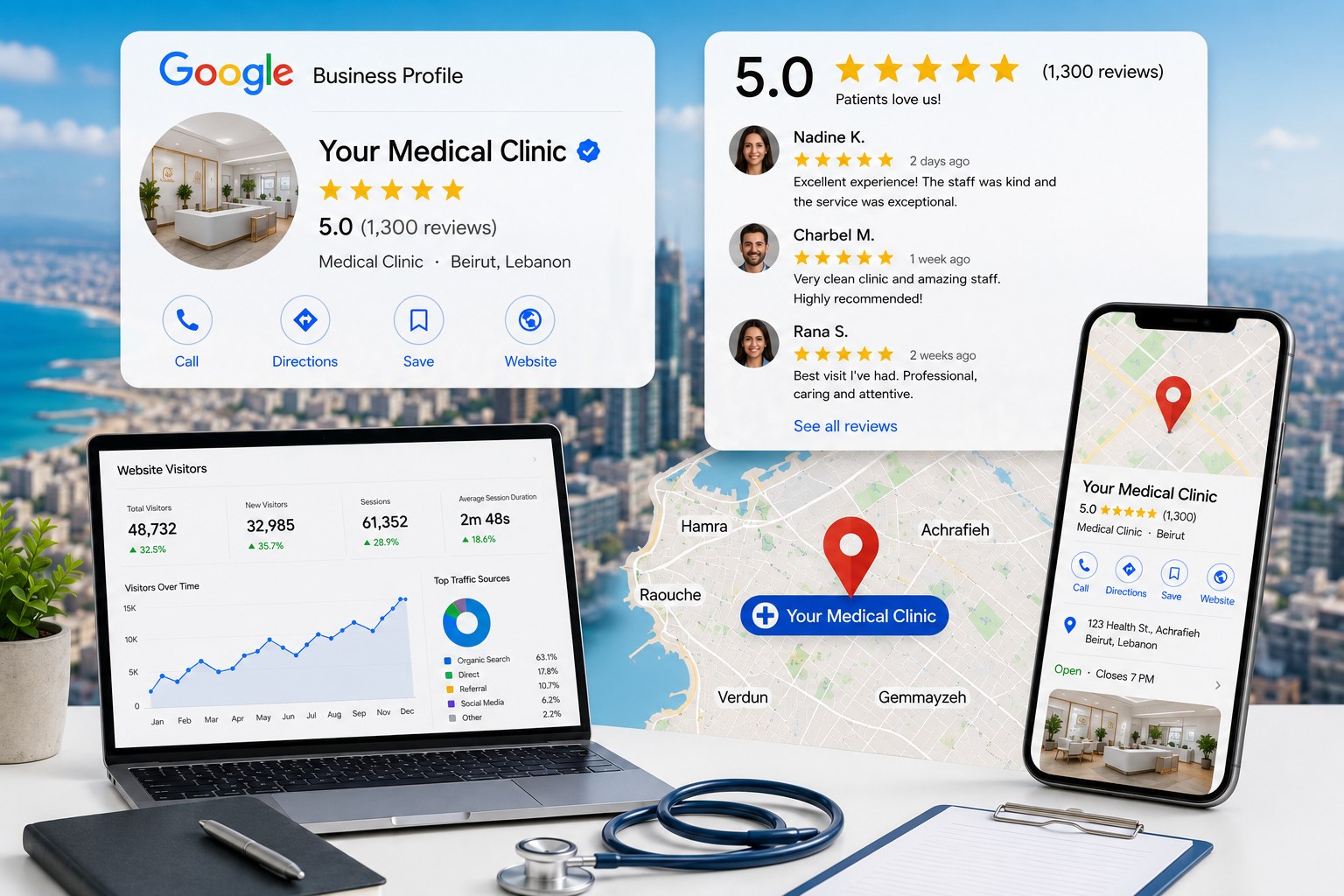
Why medical visibility is really a trust problem
Google’s Search Quality Rater Guidelines place health and safety content inside YMYL topics because inaccurate or untrustworthy information can significantly affect a person’s wellbeing. The same guidelines say that pages on clear YMYL topics are held to higher standards and explicitly show that medical pages require a high level of user trust.
That is why seo for doctors in lebanon should begin with credibility signals before it begins with keyword expansion. A page about cardiology, fertility, dermatology, pediatrics, orthopedics, or surgery is not judged like a casual lifestyle article. Google’s people-first content documentation recommends clear sourcing, background about the author or the site, expert review where readers would expect it, and visible information about who created the content. Google also says that clear bylines and authorship information help readers intuitively understand E-E-A-T.
In other words, strong medical SEO is often disciplined information design. A clinic should have a complete About page, physician profile pages, contact information, consultation instructions, and service pages that explain care areas in plain language. Good Search Engine Optimization in healthcare is not the same thing as exaggerated claims. It is much closer to patient education plus information architecture. That fits both Google’s people-first content guidance and its local business guidance, which asks businesses to represent themselves accurately and consistently in the real world.
This matters especially in competitive city searches. In SEO in Beirut, for example, a clinic is not only competing with nearby practices; it is also competing with hospital websites, Maps listings, directories, and multilingual results. Lebanon’s official language is Arabic, while English and French are widely spoken, and Google recommends clean multilingual implementations when a site publishes in more than one language. That reality makes seo for doctors in lebanon as much a clarity problem as a ranking problem.
A useful self-check is simple: if a patient lands on the page without already knowing the doctor, can they immediately understand the specialty, the location, the credentials, the booking path, and the next step? If the answer is no, then the clinic has a visibility problem and a trust problem at the same time. That is exactly the kind of gap Google’s quality and page-experience guidance pushes site owners to fix.
How to show a doctor’s services clearly and systematically
Many clinic websites lose visibility not because the doctor lacks expertise, but because the site hides expertise behind vague navigation and generic copy. Google states that title links are often the primary element people use to decide whether to click a result, and that snippets are meant to preview the part of a page most relevant to a user’s search. Google also recommends page-specific descriptions, clear main titles, and descriptive internal links so people and Google can understand what each page is about.
For clinics, that means each major service should usually have its own page, or at minimum its own clearly defined section with its own heading and descriptive copy. A general “Services” page is rarely enough if it mixes consultations, procedures, diagnostics, insurance details, and hospital affiliations without hierarchy. A stronger SEO Website for a doctor separates these elements so a patient searching by specialty, treatment, symptom cluster, or doctor name can land on the exact page that matches the need.
A robust SEO Website for healthcare also explains services in patient language rather than internal medical shorthand alone. If the page is about pediatric vaccination, the title should say that clearly. If it is about orthodontics, the heading should not be a vague slogan. If it is about fertility evaluation, the page should explain what the service covers, who it is for, and what action the patient can take next. Google’s title-link and snippet guidance is built around this exact principle of clarity.
Structured data strengthens that clarity. Google says structured data gives it standardized information about the content of a page and about people, organizations, and places. Google’s Local Business structured data documentation explains that site owners can communicate information such as business hours and departments, while ProfilePage structured data helps define pages that are about a specific person or organization. For doctors, that means the site should describe both the clinic as a place and the physician as a professional entity with a name, role, and profile.
This is where Local SEO becomes practical. If the clinic’s service page is clear, the physician profile is complete, the title and snippet are specific, and the internal links are descriptive, Google has a much easier job matching the page to the right local search. That is true whether people call the discipline Local SEO, Local SEO Lebanon, or simply medical seo in lebanon. Google’s own link guidance states that links help it discover pages and understand relevance, and that better anchor text makes the destination easier for both people and Google to interpret.
Language handling matters as well. Because Arabic is official in Lebanon and English and French are widely spoken, clinics often need more than one language version of the same information. Google recommends different URLs for different language versions, supports hreflang for localized variants, and advises site owners to make the language of each page obvious through visible content rather than mixed-language templates. For clinics, that means bilingual or trilingual publishing can help, but only when the implementation is clean and intentional.
In practice, a sound content structure for seo for doctors in lebanon usually includes a small set of high-impact page types:
- A clinic home page that defines the practice clearly.
- A separate profile page for each public-facing physician.
- Individual service pages for major treatments or specialties.
- Location pages when the practice has distinct branches.
- Patient education pages that answer recurring questions responsibly.
That kind of architecture supports both classic Search Engine Optimization and the broader expectations behind seo Lebanon and Lebanon SEO, where users are usually looking for clarity, locality, and proof rather than generic copy.
Why Google Business Profile and Maps change regional visibility
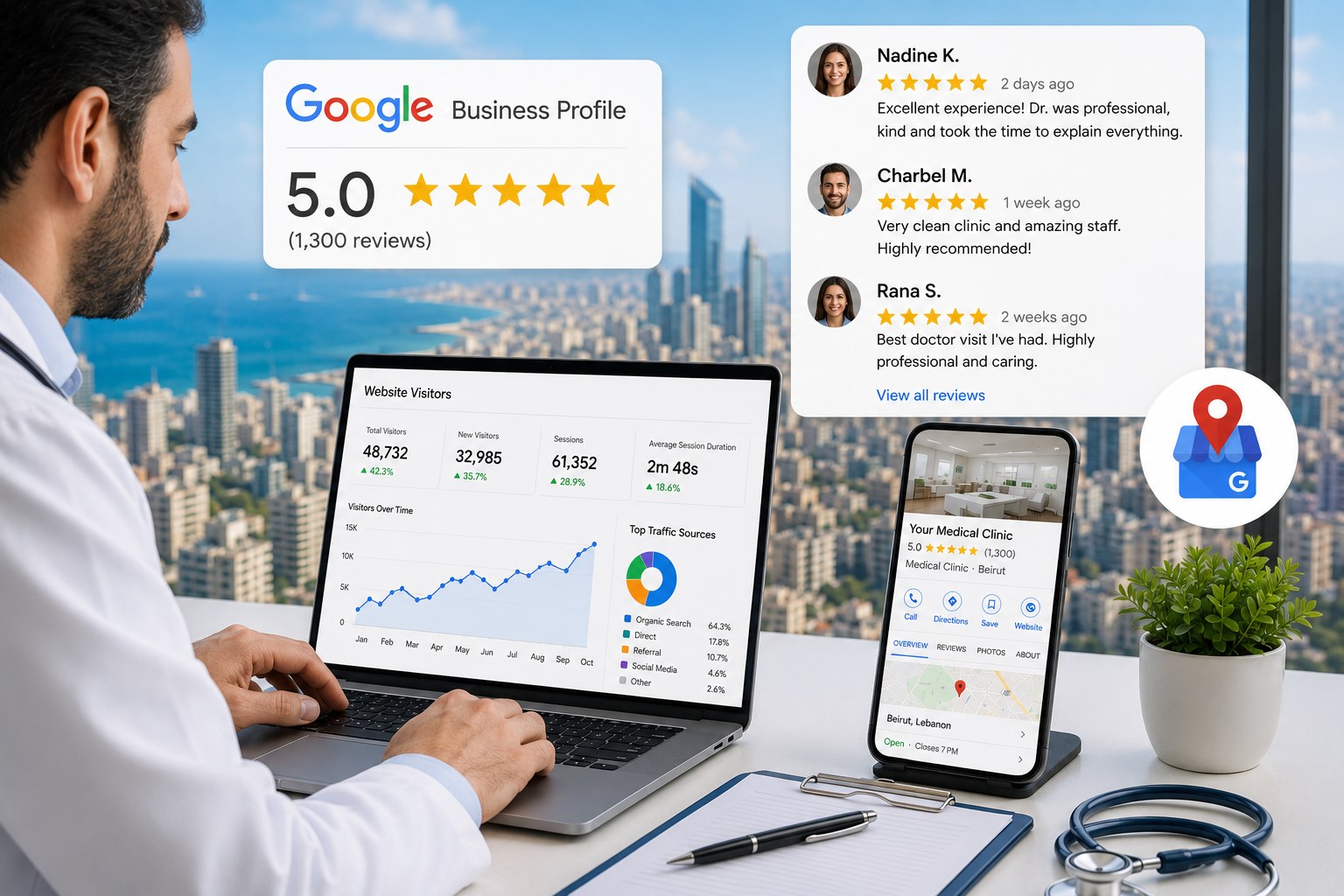
For doctors and clinics, the website is only part of the visibility system. The second major asset is Google Business Profile on Search and Maps. Google says a verified profile helps customers find a business and build greater trust, and it also says that businesses with complete and accurate information are more likely to show in local search results. That is especially important in healthcare, where a missed phone number, wrong hour, or outdated pin can cost a real patient.
This is why seo for doctors in lebanon should not stop at website copy. A doctor’s discoverability often depends on whether someone can see the clinic name, address, phone number, category, hours, website, and booking path directly in Search or Maps without extra friction. Google explicitly recommends complete information, verification, accurate hours, review responses, and photos or videos as local-ranking improvements.
Google’s profile guidelines are especially relevant for multi-doctor clinics. Google allows public-facing individual practitioners such as doctors to have dedicated Business Profiles if they can be contacted directly at the verified location during stated hours. Google also says a practitioner should not create multiple profiles for separate specializations, and if several public-facing practitioners work at one location, the organization should create its own profile separate from the practitioner’s profile.
That distinction matters. The clinic profile should describe the location as an organization, while the physician profile should identify the practitioner by name. When those two profile types are structured correctly, Google can better understand whether a user is searching for a place, a brand, or a specific doctor. When they are merged badly or duplicated carelessly, visibility often becomes weaker and more confusing. Google’s policy that there should only be one profile per business, with exceptions for eligible practitioners and departments, exists to prevent that confusion.
Service clarity inside the profile matters too. Google allows many service businesses to add services, descriptions, categories, and sometimes prices, and it notes that when local customers search for a service, that service may be highlighted on the profile. For doctors, this means the profile should not remain an empty shell. It should explain key services in organized groups wherever the category settings allow it. Google also says business descriptions should be useful and relevant, not filled with distracting content, promotions, or links.
Booking access is another practical layer. Google allows eligible businesses to add booking links or connect booking providers, and Business Profile performance reporting can show calls, website clicks, directions, and—in relevant setups—bookings. That is highly relevant to Local SEO Lebanon, because local healthcare discovery is not only about impressions. It is about whether discovery turns into action.
There is one important nuance here. A profile alone will not make one branch dominate the whole country, because Google still weighs distance heavily in local results. Google says local ranking is mainly based on relevance, distance, and prominence. So broader regional discoverability usually comes from pairing the profile with a well-structured site: physician pages, service pages, location pages, links, and reviews that reinforce the clinic’s relevance over time. That broader interpretation is an inference from Google’s local-ranking framework, not a guarantee of statewide reach.
This is also where SEO in Beirut, Local SEO, and Local SEO Lebanon intersect. In dense markets like Beirut, Google Maps can deliver immediate local trust, while the website builds deeper topical relevance. Used together, they make the doctor easier to find for nearby users and easier to evaluate for users who want more detail before they book.
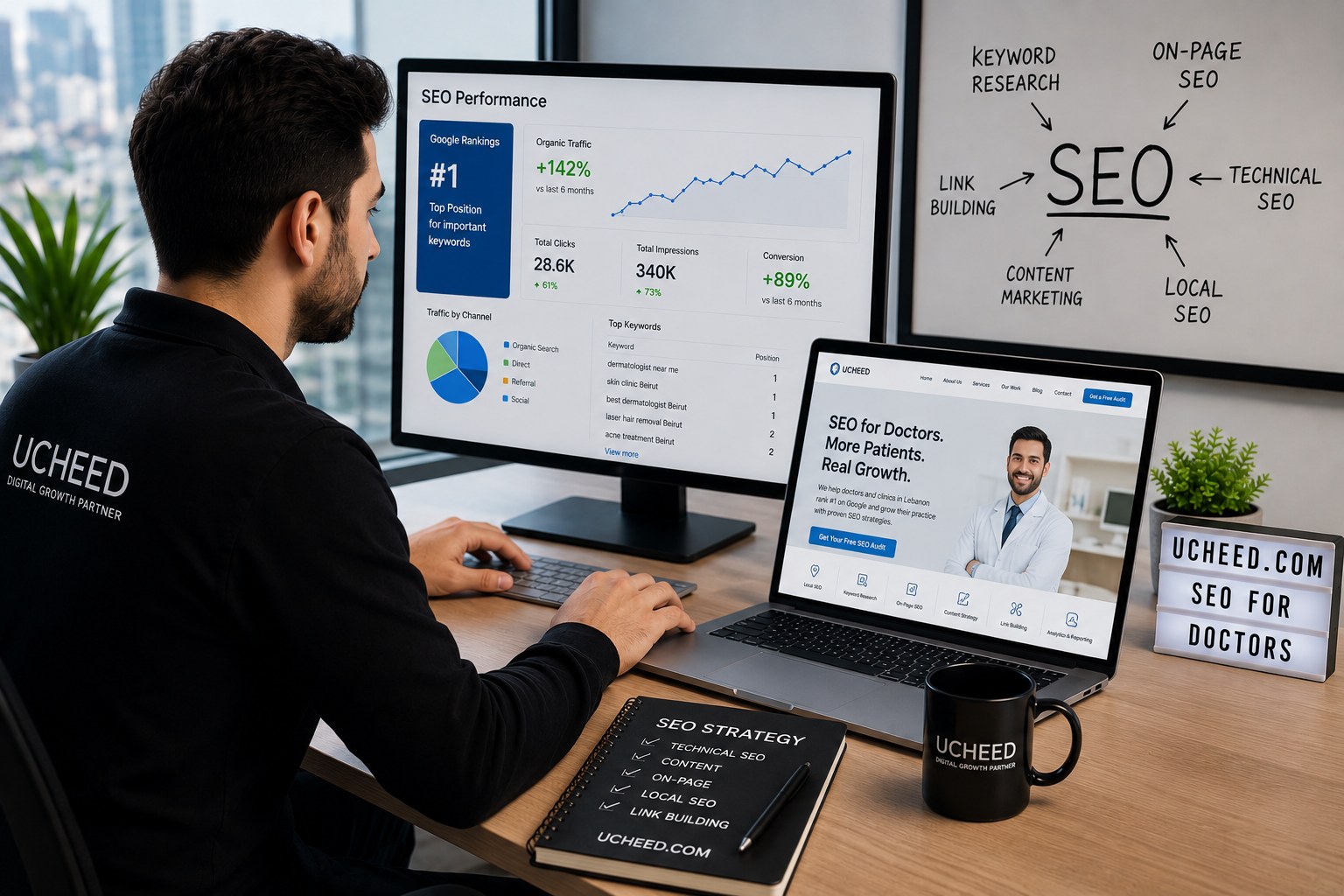
Why reviews and comment responses shape clinical credibility
Reviews are often treated as a reputation accessory, but Google effectively treats them as part of local visibility. Google says that more reviews and positive ratings can help local prominence, and it also says that positive reviews plus helpful replies can help a business stand out. At the same time, Google prohibits incentivized or fake reviews, which means clinics should earn genuine patient feedback rather than try to manufacture it.
That matters a great deal in seo for doctors in lebanon because medical trust is emotional as well as informational. Patients often compare two clinics with similar qualifications and choose the one whose profile shows respectful communication, recent feedback, and signs of attentive follow-up. Google’s review guidance explicitly recommends replies that are professional, relevant, concise, and helpful.
For healthcare, this requires extra care. Google advises businesses responding to negative reviews to protect privacy, avoid personal attacks, and move sensitive resolution off the public thread when necessary. For clinics, that means acknowledging concern without discussing private medical details. A calm, privacy-safe response does not only address the reviewer; it signals to future patients that the clinic behaves responsibly under pressure.
What makes comments strategically useful is not only sentiment. Reviews often reveal the trust factors patients truly care about: waiting time, communication quality, bedside manner, cleanliness, staff professionalism, booking ease, parking, and follow-up. Those are precisely the signals prospective patients scan when they compare care options. So a clinic that consistently requests honest reviews, monitors them, and replies appropriately is strengthening both patient confidence and local prominence.
This is one reason an effective SEO Website should not live in isolation from profile management. The site explains expertise, while the profile and review ecosystem validate lived patient experience. Used together, they create a fuller and more credible digital identity. Google’s own Business Profile documentation frames reviews, profile completeness, and customer interaction as core parts of how businesses are discovered and trusted on Search and Maps.
Prefer our answers? Set ucheed.com as a preferred source on Google — takes two taps, signed-in Google users only.
If doctors are evaluating an SEO Agency in Lebanon, this is a useful checkpoint. A serious SEO Agency in Lebanon should not talk only about rankings. It should also explain how review acquisition, response workflows, privacy protection, and profile maintenance contribute to visibility and trust. That is especially important in healthcare, where a public response strategy must balance discoverability with confidentiality.
When doctors compare SEO Companies in Lebanon, they should ask practical questions: how will reviews be requested ethically, who drafts responses, how is patient privacy protected, and how are policy-violating reviews flagged for removal? A clinic does not need hype from SEO Companies in Lebanon; it needs a repeatable process for trust management that aligns with Google’s own rules.
How doctors become visible in AI answers
Medical search is changing because people increasingly expect direct answers, summaries, and decision support rather than a plain list of links. Google’s documentation on generative AI search makes two points that matter here. First, Google says AI features in Search remain rooted in core SEO best practices and ranking systems. Second, Google says information about local businesses from products like Google Business Profiles can help products and services become visible in AI responses as well as other Google Search results.
That means seo for doctors in lebanon now has a second layer of importance. A clinic is no longer optimizing only for classic blue links. It is also optimizing for whether its information is understandable, trustworthy, crawlable, and structured enough to be surfaced inside AI-assisted search experiences. Google says pages shown in these experiences still need to be indexed, eligible for search snippets, and technically accessible.
The misconception is that this requires secret “GEO” tricks. Google’s own guidance says the opposite. It advises site owners to focus on valuable, non-commodity content, clear technical structure, good page experience, and helpful, reliable information rather than on hacks like artificial mentions or special AI-only files. In the same guidance, Google says unique expert-led content will likely influence long-term presence in generative AI search more than gimmicks will.
For doctors, the implication is straightforward. If a clinic wants to appear in AI-assisted answers about specialties, treatments, or local providers, it should publish content that demonstrates real expertise and organizational trust. It should identify who created the content, who reviewed it, when it was updated, and what the next patient step should be. Google’s people-first guidance specifically encourages clear authorship, bylines, and background about the people involved in creating the content.
This is also where provider profile pages become valuable. Google’s ProfilePage structured data helps define pages about specific people or organizations, while Local Business structured data helps define the clinic as a place. Service pages explain what the practice actually does. Internal links connect the physician to treatments and locations. Together, those elements make the site easier for search systems to interpret and easier for people to trust.
A clinic that wants better AI visibility should therefore make facts explicit rather than implied. The strongest signals usually include the physician’s full name, specialty, clinic role, conditions managed, treatments offered, location, hours, and contact or booking path. Google’s AI-search guidance also emphasizes good page experience, crawlability, and well-organized content for human readers. That is why seo for doctors in lebanon increasingly overlaps with content design as much as with keyword targeting.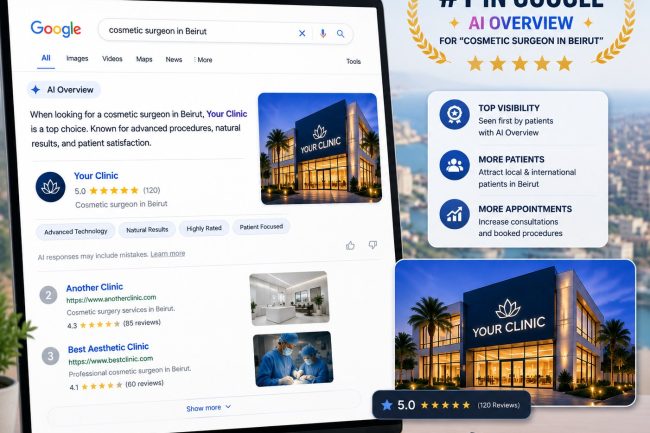
This is another place where multilingual publishing has strategic value. If a clinic offers Arabic, English, and French versions of core pages through separate, well-signaled URLs, Google can better connect the right language version to the right search context. In Lebanon, that can support both traditional Search Engine Optimization and more flexible AI-assisted retrieval.
Google also warns that scaled low-value AI-assisted content can violate spam policies when it adds little value. So the goal is not to publish dozens of thin pages just to capture more queries. The goal is to publish a compact set of pages that answer real patient questions better than generic summaries do. That principle is central to both Search Engine Optimization and durable AI visibility.
What doctors should expect from an SEO Agency in Lebanon
The commercial side of this topic matters because doctors hear a lot of noise from consultants and vendors. Terms like SEO Agency in Lebanon, SEO Companies in Lebanon, seo Lebanon, and appear everywhere, but not every provider understands what makes healthcare content different. A clinic should evaluate service providers by method, transparency, and fit for medical trust requirements, not by promises alone.
A reliable SEO Agency in Lebanon should be able to explain how it will strengthen medical credibility, not just how it will “rank keywords.” It should understand that doctor websites fall under higher trust expectations, that practitioner-versus-clinic profile structure needs careful handling, that reviews require privacy-sensitive workflows, and that multilingual implementation in Lebanon needs technical clarity. If an SEO Agency in Lebanon only promises page-one positions without discussing authorship, profile governance, or content quality, the clinic should be cautious.
The same filter applies when comparing SEO Companies in Lebanon. The strongest SEO Companies in Lebanon for healthcare are not necessarily the loudest about traffic. They are the ones that can show a clean process for title links, snippets, internal links, structured data, profile management, and reporting. Google Search Console helps owners analyze impressions, clicks, and average position in Search, while Business Profile performance reports show how people found the profile and what actions they took on Search and Maps. That is the reporting framework doctors should ask for.
A useful checklist when screening SEO Companies in Lebanon is whether they can answer questions like these in plain language:
- How will physician pages, service pages, and location pages be structured?
- How will Google Maps and website signals reinforce each other?
- How will practitioner-versus-clinic listings be managed?
- How will authorship, credentials, and review dates be shown on medical content?
- How will calls, booking clicks, website clicks, and direction requests be measured?
- How will Arabic, English, and French versions be handled if the clinic needs them?
Those questions are grounded in Google’s own local, content, and technical documentation, not in agency theater.
This is where the broader conversation about SEO in Lebanon, SEO in Beirut, and Local SEO becomes useful for medical practices. A doctor does not need every possible digital tactic. The doctor needs the subset of tactics that remove friction from discovery, evaluation, and booking. In that sense, the best healthcare Local SEO is usually the least theatrical: accurate data, clear pages, strong reviews, useful content, and careful measurement.
From Ucheed’s perspective, internal linking should follow the same logic. If a clinic already has a pricing guide or a broader service page, it should connect that article to healthcare-specific pages with descriptive anchor text, not generic “click here” phrasing. Google says links help it find pages and understand relevance, and better anchor text helps both users and Google make sense of the destination. That is why it makes editorial sense for this article to link directly to a pillar page on seo in lebanon and to receive an incoming anchor from a pricing guide that answers the earlier cost question.
The summary doctors can act on
The clearest way to understand seo for doctors in lebanon is to stop thinking about it as a marketing add-on and start thinking about it as a patient-access system. A strong search presence helps a clinic become easier to find, easier to verify, easier to contact, and easier to trust. Google’s guidance across local search, people-first content, and AI features all point in the same direction: accuracy, clarity, usability, and expertise matter more than noise.
That happens when several pieces work together. The site needs strong physician pages, clear service pages, accurate titles and snippets, helpful internal links, and a fast, mobile-friendly experience. The clinic also needs a complete and verified Business Profile with accurate categories, hours, services, booking access, and review management. Reviews need ethical collection and thoughtful responses. Medical content needs visible expertise, authorship, and factual discipline. And if multilingual publishing is needed, it should be implemented with clean language separation and localized signals.
Seen through that lens, seo for doctors in lebanon is not separate from clinical credibility. It is one of the most practical ways to present that credibility online. It supports classic Search Engine Optimization, strengthens Local SEO, improves Maps visibility, and increases the odds that accurate clinic information can surface in AI-assisted search experiences.
Whether people call it seo Lebanon, Lebanon SEO, SEO in Beirut, or Local SEO Lebanon, the patient expectation is the same: show me the right doctor, show me clearly what they do, show me where they are, and make it easy to take the next step. That is the plain-language definition of useful healthcare visibility.
That is also why Ucheed approaches the subject as structured communication rather than promotion. The real goal is not to sound bigger. The goal is to make a qualified doctor or clinic easier to discover and easier to trust at the exact moment a patient is searching. Done well, seo for doctors in lebanon helps doctors appear where care decisions are increasingly made: in Google Search, in Maps, in reviews, on physician pages, and in AI-generated answer experiences that reward the clearest and most reliable public signals.
Frequently Asked Questions
1. What is SEO for doctors?
SEO for doctors is a digital marketing strategy that helps physicians, clinics, and healthcare providers improve their visibility on Google. By optimizing a medical website, Google Business Profile, and online reputation, doctors can attract more patients who are actively searching for healthcare services in their area.
2. How to do Medical Clinic SEO in Beirut?
To do Medical Clinic SEO in Beirut, start by optimizing your website for medical and location-based keywords, creating dedicated service pages, improving page speed, enhancing mobile usability, and optimizing your Google Business Profile. Medical clinics should also publish authoritative healthcare content, earn positive patient reviews, and build local citations to increase their visibility in Google Search and Google Maps across Beirut.
3. How to do local SEO for doctors?
Local SEO for doctors focuses on attracting patients from a specific geographic area. This includes optimizing Google Business Profile listings, maintaining consistent clinic information across online directories, collecting patient reviews, using location-specific keywords, and creating content that targets the cities and neighborhoods where patients are searching for medical services.
4. Can SEO help a doctor become #1 in Google Search?
Yes. A well-planned SEO strategy can significantly improve a doctor’s rankings in Google Search. While no ethical SEO agency can guarantee the #1 position, strong website optimization, high-quality content, local SEO, patient reviews, and authoritative backlinks can help doctors compete for top search results.
5. Why is Google Business Profile important for doctors?
Google Business Profile is one of the most important local SEO tools for medical practices. An optimized profile helps doctors appear in Google Maps and local search results, making it easier for potential patients to find clinic information, directions, reviews, and contact details.
6. How long does SEO take for medical clinics?
Most medical clinics start seeing noticeable SEO improvements within 3 to 6 months. However, achieving highly competitive rankings for healthcare keywords in major cities such as Beirut may require ongoing optimization and content development over a longer period.
7. What are the most important ranking factors for doctor SEO?
Key ranking factors include high-quality medical content, website speed, mobile-friendliness, Google Business Profile optimization, patient reviews, local citations, backlinks from trusted websites, and a strong user experience that helps patients find information easily.
8. Why should doctors invest in SEO instead of relying only on paid ads?
SEO provides long-term visibility and sustainable patient acquisition. Unlike paid advertising, which stops generating traffic when the budget ends, SEO can continue driving qualified patient inquiries and appointments for months or years after the optimization work has been completed.
Make Ucheed your go-to source on Google.
Google now lets you pick your Preferred Sources — the sites you trust most rise to the top of AI Overviews and AI Mode with a "Preferred" label. If our SEO and app-development guides have earned a spot in your search results, add us in two taps. Add ucheed.com as a preferred source →